

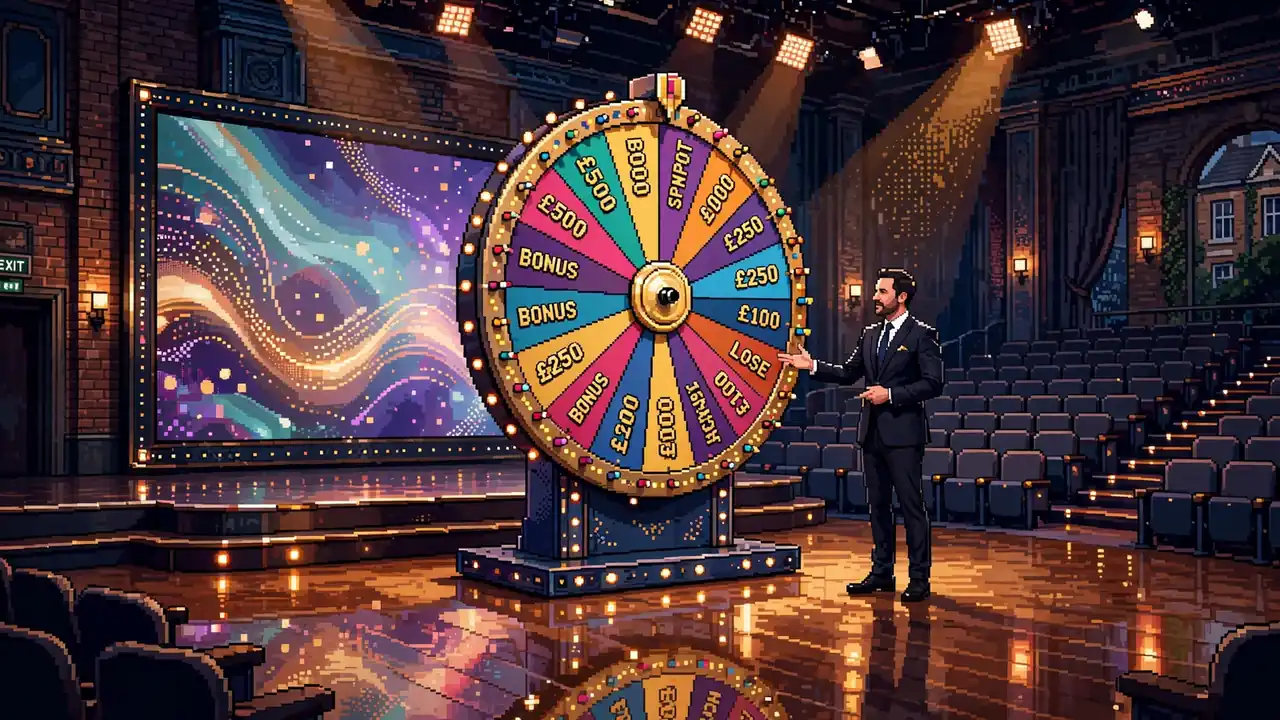
Live casino game shows combine a presentation format with remote casino content, but the labels alone do not define a title, rules or betting structure.
How Live Casino Game Shows Differ from Conventional Casino Games
The expression “live casino game shows” combines two ideas that are often treated as though they were interchangeable. A casino game is the gambling product itself. A game show is a presentation format associated with entertainment, participation, or staged interaction. When the two are combined, the phrase describes a form of remote casino content presented through a live-show concept rather than a conventional game interface alone.
That distinction matters because “live” does not, by itself, define a particular game. It can describe the way content is presented, while “game show” describes the surrounding format. Neither word identifies a specific title, rule set, betting structure, return rate, or operator. Consequently, labels such as “best online casino game shows” and “best live casino game shows” should not be treated as technical classifications. They are broad descriptions of a product category.
The central difference is presentation
Conventional online casino games are generally encountered as software interfaces. The player selects a game, views its available controls and information, and interacts with the digital representation provided by the operator or software supplier. The identity of the game is ordinarily conveyed through its title, rules, symbols, tables, reels, or other interface elements.
A live casino game show is framed differently. Its defining emphasis is the show-like presentation attached to the gambling product. The visual identity, language, pacing, and layout may be designed to resemble an entertainment programme rather than a conventional standalone casino interface. That does not establish any particular method of play. It establishes only that the product is presented as a live show within a casino setting.
This is an important separation. A product can have an elaborate visual presentation without changing the legal or commercial nature of the activity. If it offers casino gambling to consumers in Great Britain, it remains part of the remote gambling market and is not converted into a non-gambling entertainment product merely because its presentation resembles a show.
Slots & Providers: UK Casino Game Categories
The word “conventional” is also relative. It does not refer to one defined group of games. It is useful as shorthand for casino content encountered without the specific game-show framing. That may include software-based casino products and other casino formats, but the label alone says nothing about the details of any individual title.
“Live” is not the same as “interactive”
The word “live” can lead to overstatement. It signals a presentation associated with live content, but it does not automatically prove that every element is conducted in real time, that a presenter is involved, or that participants can communicate with one another. Nor does it establish that the outcome is determined in a particular way.
Similarly, a live-show label should not be confused with a guarantee of social interaction. Some products may place greater emphasis on shared viewing or broadcast-style presentation; others may use the label as part of their category or marketing language. The presence of the word “live” is therefore not enough to infer a common set of functions.
This distinction is relevant when comparing an online casino with live game shows against an operator offering conventional casino content. The comparison should concern the actual product description and rules, not assumptions drawn from the name. A title described as live may differ substantially from another title carrying the same broad label. The category identifies a style of presentation, not a uniform technical specification.
A show format does not determine the gambling conditions
A game-show presentation does not, by itself, determine the conditions attached to a wager. It does not specify the available stake, the applicable return-to-player setting, the probability of an outcome, the treatment of a winning bet, or the terms of any promotion. Those matters belong to the product rules and the operator’s terms.
The same caution applies to comparisons with conventional casino games. A show-like interface should not automatically be described as more generous, more entertaining, more transparent, or more favourable. Those are separate propositions requiring separate information. Presentation and gambling conditions are related only where the rules expressly connect them.
No-Limit Online Casinos in the UK: Rules Explained
This also means that the word “best” cannot be given a fixed meaning without a stated criterion. “Best online casino game shows” might refer to presentation, range, interface design, availability, or some other consideration. It is not a measurable attribute in itself. A responsible comparison would need to identify the basis on which products are being assessed and distinguish observable features from subjective preference.
The role of the interface
The interface is one of the clearest practical points of comparison. Conventional casino software commonly places the game controls, information panels, and outcome display at the centre of the screen. A live game-show product may give greater visual prominence to the show environment or to the presentation surrounding the gambling activity.
That difference can affect how the product is understood, but it does not remove the need to examine the underlying rules. A more prominent presentation may make the experience feel less like a traditional casino table or machine. It does not follow that the product has different legal status, different probabilities, or different consumer protections.
The distinction can also be expressed in terms of emphasis. Conventional casino content tends to foreground the game interface. Live casino game shows foreground the relationship between casino play and show presentation. The boundary is not absolute, because a conventional product can have strong visual design and a live product can still rely on familiar casino controls. The categories describe emphasis rather than mutually exclusive technical systems.
Why titles should not be treated as evidence of format
A product name may suggest a show, a theme, or a style of presentation, but a name is not a substitute for rules. The title alone cannot establish whether the product is live, whether it contains a presenter, whether it includes audience features, or how an outcome is generated.
This is particularly important for lists described as the best live casino game shows. A list can appear precise while grouping together products that have only a broad marketing association in common. Without a consistent definition, one entry might be included because of its visual style, another because of a live broadcast element, and another because an operator places it in a game-show category. Such a list would compare unlike features unless its criteria were made explicit.
Amatic Casinos in the UK: Licensing and Game Access
The same issue affects the phrase “online casino game shows”. It may be used as a general category covering several forms of casino content. It should not be read as evidence that all products carrying the label share the same format or mechanics.
Live presentation and conventional software are not opposites
The contrast between live game shows and conventional casino games is sometimes presented too sharply. Live presentation and software operation can coexist. A product may use software to display information, process bets, and record outcomes while being presented through a live-show framework. Conversely, a conventional casino product may use animation, sound, and elaborate visual design without being a live game show.
The meaningful comparison is therefore not “human” versus “computer” or “entertainment” versus “gambling”. It is the way the product is presented and categorised. The show element concerns the presentation surrounding casino play; the software element concerns how the product is delivered and operated. These are different dimensions.
That distinction also prevents an unsupported assumption that one format is inherently more authentic than another. A live label does not establish greater fairness, and a conventional digital interface does not establish the opposite. Those conclusions would require information about the specific product, its rules, and the operator providing it.
Availability is a separate question
The phrase “online casino with live game shows” describes an operator or platform in relation to a product category. It does not establish that every casino using the phrase offers the same titles, retains them permanently, or makes them available to every account. Product catalogues can be described at a general level, while actual availability depends on the operator’s current offering and the relevant market.
The presence of a category in a casino lobby should therefore be distinguished from the existence of a particular title. A lobby label may group products for navigation, but it does not define the mechanics of each entry. A casino may also use different labels for substantially similar content, making direct comparison difficult unless the individual product pages are examined.
Amatic Games at UK Online Casinos: What to Check
Availability should also not be confused with quality. A product can be listed without being “best”, and a product’s inclusion in a category does not establish a ranking. The terms “top”, “best”, and “leading” are evaluative descriptions rather than evidence of a common standard.
The UK context does not create a separate definition
In the United Kingdom, the relevant legal question is whether an activity constitutes casino gambling offered remotely to consumers and whether the operator is permitted to provide it. The Gambling Act 2005 defines a casino by reference to an arrangement giving people an opportunity to participate in one or more casino games. That definition concerns the gambling activity, not whether the product is styled as a programme, broadcast, or show.
The presentation therefore does not create an exemption from the ordinary framework for remote gambling. A live game-show label cannot, on its own, turn casino content into a different class of activity. Nor does the label by itself determine which operator, licence, terms, or protections apply. Those questions concern the operator and the service being supplied.
This legal perspective helps maintain the distinction between form and substance. The show format may be central to how a product is experienced and marketed. The underlying activity remains subject to the rules applicable to remote casino gambling where those rules apply.
A careful basis for comparison
A meaningful comparison between live casino game shows and conventional casino games can use several separate dimensions:
- Presentation: whether the product is framed as a show, a standard casino game, or another format.
- Interface: how the product displays controls, information, outcomes, and surrounding content.
- Participation: what forms of interaction the product expressly describes, without assuming that “live” means social interaction.
- Rules: the conditions governing wagers, outcomes, and settlement.
- Availability: whether a particular operator currently offers the specific product.
- Regulatory status: whether the operator is authorised to provide the relevant remote gambling service in Great Britain.
These dimensions should not be collapsed into a single judgement. A product may have a show-style presentation but conventional software controls. Another may have a live visual environment but limited interaction. A third may use a game-show label while differing materially in its rules. The category remains useful, but only when treated as a description of presentation rather than a promise of shared mechanics.
Live casino game shows are therefore best understood as casino products distinguished primarily by their show-oriented presentation. Conventional casino games provide the comparison point: content presented without that specific framing. The distinction helps explain why the category attracts separate attention, while the product name alone remains insufficient to establish how any particular game operates.
Top online casinos in the UK
- x3betBonus: Welcome Pack 100% Up to £1.000 + 200 Free Spins · Payout speed: 1-3 business days
- Revery PlayBonus: 100% up to€1,000+ 100 FS · Payout speed: 1-3 business days
- NightLuckBonus: Welcome Pack + 805% Up To 6400€ + 280 FS · Payout speed: 1-3 business days
- DieselwinBonus: Welcome Pack 250% up to £4000 + 200 FS · Payout speed: 1-3 business days
- ChanzeBonus: Slots Welcome Bonus #1 200% up to €500 · Payout speed: 1-3 business days
- SlotoSportBonus: 500% up to £ 10 200+ 777 FS · Payout speed: 1-3 business days
- EvoSpinBonus: 125% up to €2500 + 125 Free Spins · Payout speed: 1-3 business days
- AmunbetBonus: Join now and get 450% up to 2,700 GBP + 450 FS · Payout speed: 1-3 business days
- JetsetspinsBonus: 200% Bonus + 100 Free Spins + Free Royal Wheel · Payout speed: 1-3 business days
- NightWinBonus: £900 + 400 free spins · Payout speed: 1-3 business days
UK Casinos and the Regulation of Live Game Shows
Live game shows offered through a UK casino fall within the wider regulatory system for remote gambling. The relevant authority is the UK Gambling Commission, which oversees commercial gambling in Great Britain and covers online casino activity within that remit. A live presentation, streamed dealing environment or interactive show format does not place a casino product outside that system merely because part of the experience is delivered through video or other remote technology.
The central regulatory question concerns the gambling service being offered to consumers in Great Britain. The physical location of the equipment used to provide that service does not determine whether UK oversight applies. Servers, studios, technical infrastructure and other essential equipment may be located elsewhere, but that fact does not remove a remote gambling service from the Commission’s jurisdiction when it is offered to consumers in Great Britain.
The role of the UK Gambling Commission
The UK Gambling Commission is the sole regulator for commercial gambling in Great Britain. Its remit includes remote gambling and online casino services, so an operator presenting casino products through an internet platform falls within the same broad regulatory structure as other commercial gambling businesses.
Amatic Online Casinos UK: Games and Access
That structure is concerned with the businesses conducting the gambling activity, rather than with the visual appearance of an individual product. A casino game shown through a live broadcast remains part of a regulated gambling service when it is offered commercially to customers in Great Britain. The live format may affect how the product is presented, but presentation alone does not create a separate regulatory authority or an exemption from the Commission’s oversight.
This distinction matters because a platform can include many types of casino content while remaining subject to one principal regulatory framework. The presence of a host, studio, streamed table or game-show presentation does not in itself indicate that a different licence is required from a different British regulator. The relevant regulator for commercial gambling in Great Britain remains the UK Gambling Commission.
Operating licences and the business behind the casino
The Commission issues operating licences to businesses that conduct gambling activities in Great Britain. In the context of an online casino, the operating licence relates to the business providing the gambling service rather than to the title of a particular game or to the studio-style presentation used for that game.
An operator offering casino products remotely therefore occupies a different regulatory position from a software supplier, production company or other commercial participant that does not itself provide the gambling service to customers. The existence of a recognisable game brand, a live production environment or a separate technology provider does not by itself show which business is responsible for the consumer-facing gambling activity. That responsibility rests with the licensed operator conducting the relevant commercial service.
This is also why the name of a game or show cannot, by itself, establish that an online casino is authorised to offer it in Great Britain. A product name identifies content. It does not replace the operator’s regulatory status, and it does not demonstrate that the service through which the product is made available holds the necessary UKGC licence.
Regulatory status belongs to the business operating the gambling service, not the name of the game or the visual style of the production.
The same principle applies to an online casino catalogue. A large catalogue, a live casino area or a dedicated section for game-show products is not a licence category. Regulatory status belongs to the business operating the gambling service. The Commission’s role is therefore connected with the licensed undertaking and its permitted gambling activity, not simply with the labels displayed in a website menu.
Personal licences within the regulatory structure
The Commission also grants personal licences to individuals working in relevant operating roles in Great Britain. This creates a second part of the licensing structure alongside the operating licence held by the business.
The two forms of licence serve different functions. An operating licence concerns the business conducting the gambling activity. A personal licence concerns an individual whose role falls within the licensing requirements for work connected with that operation. The existence of personal licensing does not turn a presenter or other visible participant into the operator of a casino, nor does the presence of an individual licence substitute for the business’s operating licence.
This distinction is particularly relevant to live formats because the public-facing part of a broadcast may be associated with presenters, dealers, production staff or other individuals. Their visibility in the programme does not determine who is legally providing the gambling service. The regulatory assessment remains tied to the business conducting the commercial gambling operation and to the applicable licensing arrangements.
A live game-show environment can therefore involve several commercial participants without creating several equivalent operators. The business offering remote casino gambling and the people working within that business occupy different positions in the licensing framework. Treating those roles as interchangeable would confuse the operator’s authorisation with personal licensing.
Great Britain and the location of technical equipment
Remote gambling regulation follows the service offered to consumers in Great Britain, not merely the place where the technical infrastructure is installed. This rule prevents the location of key equipment from being used as a simple way to avoid UK oversight.
Wazdan Casinos in the UK: Amatic Evidence Explained
For online casino services, the practical consequence is that an operator cannot rely solely on an overseas studio, server or technical arrangement to determine its regulatory position. The relevant issue is that remote gambling is being offered to consumers in Great Britain. The Commission’s authority extends to that activity even when important equipment connected with the service is located outside the country.
This principle is important for live products because the broadcast or game environment may be produced in a different location from the customer-facing website. A studio abroad and a website accessible in Great Britain are not, by themselves, evidence that the service sits outside British regulation. Technical geography and regulatory responsibility are separate questions.
The same reasoning applies to a casino platform using external technology or content providers. The presence of an outside supplier does not remove the consumer-facing operator from the British regulatory framework. Nor does the location of a supplier’s infrastructure establish that the operator is authorised. The operator’s own licensing position remains the relevant starting point.
What a licence establishes
A UKGC licence establishes that the licensed business has been authorised within the Commission’s regulatory framework for the activities covered by that licence. It identifies the operator as a regulated commercial gambling business rather than an unlicensed provider operating outside the British system.
That status should not be extended beyond what it actually establishes. A licence attached to an operator does not automatically verify every product displayed on its platform, every third-party supplier connected with the service or every description used in promotional material. It establishes the regulatory position of the licensed business and the scope of its authorised operation.
Consequently, the appearance of a live casino category does not amount to independent proof that each item in that category has a separate endorsement from the regulator. The Commission regulates the gambling business and issues operating licences to businesses. It does not turn every product label, programme title or website description into a separate licence entry.
Betsoft Online Casinos in the UK: Evidence and Licensing
This is a matter of classification rather than a judgement about the quality of a particular game. A product may be presented as a live show, a casino table or another type of remote casino content. Its description does not alter the basic question of which business is providing the gambling service and whether that business operates within the relevant UK licensing structure.
What the framework means for live casino platforms
An online casino with a live game-show area is still an online casino operating in the remote gambling market. Its use of streamed or studio-based content does not create a separate legal category outside the Commission’s authority. The business offering that service to Great Britain is therefore considered within the framework governing commercial gambling and remote gambling.
This does not mean that every platform displaying similar terminology has the same regulatory status. The wording used by a website cannot establish whether the business behind it holds an operating licence. A game-show label is descriptive; the operating licence is regulatory. Those two forms of information should not be treated as interchangeable.
The distinction also prevents a common error in interpreting casino websites. A visible brand, a production studio or a software name may be prominent, while the licensed business is less visible in the presentation of the product. From a regulatory perspective, prominence is not the test. The relevant entity is the business providing the remote gambling service to consumers in Great Britain.
Where several businesses contribute to a casino product, their roles should likewise be kept separate. One company may provide technology or content, while another operates the consumer-facing casino. The UKGC operating licence is associated with the business conducting the gambling activity. A supplier’s involvement does not, on its own, demonstrate that the supplier accepts bets, manages the customer account or holds the operator’s authorisation.
The limits of product-based descriptions
Terms such as “live casino” and “game show” describe how content is presented, but they do not replace the legal categories used to identify the regulated business. The same product language can appear in different commercial settings, and a website’s terminology is not a substitute for the operator’s licensing status.
Amatic Online Casinos in the UK: Operator Guide
For regulatory purposes, the important relationship is between the operator, the gambling service and the consumers in Great Britain. The Commission’s remit covers gambling activity, including online casino services, while the operating licence is issued to the business responsible for conducting that activity. Personal licences apply separately to relevant individuals working in the industry.
This arrangement gives the regulatory framework a stable basis even when formats change. A casino may use conventional digital interfaces, streamed content or a more elaborate studio presentation. The format may change the customer experience, but it does not displace the Commission as the regulator of commercial gambling in Great Britain.
The same approach applies when a platform describes itself as a destination for live game shows or similar casino entertainment. The description does not itself demonstrate that the business is authorised, and the location of equipment does not settle the question. Regulatory status depends on the operating business and its position within the UK Gambling Commission’s licensing system.
Regulatory identity of a casino operator
For live casino services in Great Britain, three points should be kept distinct. First, the UK Gambling Commission regulates commercial gambling, including online casino activity. Second, remote gambling offered to consumers in Great Britain remains within that framework regardless of where key equipment is situated. Third, the Commission separates business authorisation from personal licensing by issuing operating licences to businesses and personal licences to relevant individuals.
Together, these principles explain how live casino products fit into UK regulation without requiring a separate regulator for every presentation format. The live element may be prominent to the customer, but the regulated entity remains the business providing the remote gambling service. A game-show title, broadcast setting or supplier relationship cannot by itself replace that regulatory identity.
What Can Be Verified About Crazy Time and Funky Time
Crazy Time and Funky Time are names associated with live casino game-show searches, but the names alone do not establish the products’ rules, presentation, supplier, availability or terms. They should therefore be treated as titles requiring identification rather than as interchangeable descriptions of a particular game format.
Amatic Games in UK Casinos: How Access Works
A title is not sufficient to establish how a game operates. The same name may appear in an editorial description, an operator’s lobby, a promotional page or a third-party catalogue, and those contexts do not carry the same evidential weight. A product page maintained by the operator or licensed provider would be relevant to the game’s current identity. An affiliate description, by contrast, may summarise the product without establishing who supplies it or whether the description remains current.
Crazy Time
The name Crazy Time can be used in connection with a live casino game show, but no particular mechanic can safely be attributed to it here. That means no wheel, bonus feature, prize structure, presenter arrangement, betting option, result-generation method or round sequence should be presented as a confirmed characteristic of the title.
The distinction matters because game-show branding can encourage assumptions. A reader may encounter references to a wheel, special rounds or bonus outcomes and reasonably regard those details as part of the product. Such details are only reliable when tied to an identifiable game listing or provider specification. Without that link, they remain descriptions that may belong to another title, an earlier version or a different product using similar promotional language.
The title also does not establish where Crazy Time is available to British customers. A mention on a casino website would not, by itself, prove that the game can be played after registration, that it is present in the current lobby, or that the operator offers it under the relevant UKGC licence. Availability is an operator-level matter and can change independently of the title’s continued existence.
Nor does the name establish the financial conditions attached to play. Stake options, minimum and maximum bets, game limits, promotional treatment and withdrawal terms are not properties that can be inferred from a title. They depend on the operator and the applicable product configuration. A casino page would need to state those conditions clearly before they could be treated as part of a current offer.
Product Titles
Names like Crazy Time and Funky Time are identifiers, not evidence of specific rules or availability.
Funky Time
The same standard applies to Funky Time. Its name identifies a subject of interest but does not, by itself, verify the game’s format or commercial distribution. No specific rules, bonus stages, host, studio, supplier, return figure or volatility characteristic should be assigned to it without a product-level reference that supports the claim.
It is also unsafe to assume that Crazy Time and Funky Time are variants of one another merely because both names contain “Time” and are discussed in similar casino contexts. Similar branding does not prove a common provider, shared mathematics, identical betting rules or the same regulatory availability. Each title requires separate identification.
A current operator listing could establish that a named casino displays Funky Time, but a general casino review would not necessarily establish that the listing remains active. The operator’s own terms would still be needed for information about deposits, withdrawals, bonus conditions and account restrictions. These commercial details should not be inferred from the game’s name or from the existence of a promotional reference.
What a proper identification would require
A dependable description of either title would connect several elements:
- The exact product name, including any provider or brand attached to it.
- A current game description explaining the relevant rules and available features.
- The operator offering it, rather than a general statement that the title exists somewhere in the market.
- The applicable UKGC status, where the product is offered to British customers.
- Current terms, covering stakes, bonuses, payments and any restrictions that affect play.
Those checks are separate. Confirming that a title exists does not confirm that a particular casino carries it. Confirming that an operator carries it does not establish that every account holder sees the same version or terms. Confirming a game’s branding does not establish its mathematical characteristics.
Accordingly, Crazy Time and Funky Time can be named as titles relevant to live casino game-show interest, but no further product description should be attached to either one without specific, current documentation. Their names do not justify a ranking, a recommendation, a comparison or a claim about which is preferable.
The Evidence Available on Live Casino Game Shows
Information about live casino game shows needs to be separated into several different questions. A title may be described as a casino product, a live-streamed programme, a promotional feature or a game-show-style gambling product, but those descriptions do not establish the same thing. A reliable account must identify the product itself, the business offering it and the regulatory status of the gambling service through which it is made available.
The strongest conclusion currently available is therefore a narrow one: live game-show casino products form a subject within remote gambling, but their individual formats, rules, titles and availability cannot be inferred from general information about online casinos. A casino licence does not, by itself, demonstrate that a particular operator offers a particular game-show product. Equally, the presence of a provider’s software on a casino website would not establish that the provider operates the casino or accepts bets from British customers.
What a firm identification would require
A product-level assessment would need more than a title or a brief marketing description. It would need to connect the named game with a specific operator and an identifiable gambling service. The relevant details would include the product’s rules, the way outcomes are determined, the role of any presenter or live broadcast, the available stakes and the terms under which the product can be played.
New online casino sites UK: licensing and offers
Those details matter because the expression “game show” does not determine the gambling mechanics. It may refer to a live presentation, a themed interface, a random-number product or another arrangement. The label alone cannot establish whether a product is a casino game, a promotional feature or a different form of remote gambling. Nor can it establish whether the same title is available in Great Britain at a particular time.
Availability is also a separate proposition from existence. A game may be associated with a supplier without being present in every operator’s lobby. In the UK market, software suppliers can distribute products to licensed operators, while the operator remains responsible for the consumer-facing account, deposits, payouts, bonus conditions and customer support. That distinction prevents a supplier’s licence or catalogue from being treated as proof that a specific live game show can be played at a named casino.
What general market information can and cannot show
Regulatory information establishes the legal framework for remote gambling supplied to consumers in Great Britain. The Gambling Commission is the regulator for commercial gambling in Great Britain, and businesses serving that market must hold the relevant UKGC licence. Those propositions concern the legal status of the operator and the gambling service. They do not confirm the title, format or technical operation of an individual live casino game show.
The same caution applies to general consumer-protection rules. Licensed operators must prompt customers to set a financial limit before the first deposit, provide access to GamStop and comply with applicable requirements concerning age, identity and payment controls. Online slot rules also prohibit autoplay and require an interval between spins, while stake limits apply to online slots according to the customer’s age. These are regulatory conditions of the market; they are not descriptions of live game-show products.
Amatic Casinos in the UK: What Listings Can Verify
Bonus rules provide another example of the distinction. The Gambling Commission’s cap on wagering requirements for bonus funds concerns the terms attached to promotions. It does not demonstrate that a particular live game show is offered, nor does it identify the game’s rules or outcome process. A promotional statement must therefore be assessed separately from the identity of the underlying product.
How claims should be treated
A claim that a casino offers live game shows should be treated as current and operator-specific. It should not be converted into a general statement about the UK market or about every casino using similar software. The relevant operator’s present product catalogue and terms would need to support the claim, because availability can change and software distribution does not create a permanent listing.
A claim about a named title requires the same discipline. The title should be linked to a clearly identified product rather than inferred from a similar name, a provider reference or an advertising phrase. Rules, presentation, eligibility and availability should not be filled in from assumptions about other casino games. Where those particulars are not established, the responsible description remains limited to the fact that the title is being discussed as a live casino game-show product.
This approach also prevents offshore and UK-regulated services from being treated as interchangeable. Offshore casinos operate outside the UKGC system and do not provide the same UK regulatory framework. Their use of a supplier’s games cannot be presented as evidence that those products are available through a UKGC-licensed operator or covered by British consumer protections.
The evidence-based position is consequently modest but useful. General information confirms the existence of a regulated remote-gambling framework and explains the division between software suppliers and consumer-facing operators. It does not, without product-specific confirmation, establish how live casino game shows work, which titles are available, or where a particular show can be played in Great Britain. Those questions remain matters for direct verification at the level of the named product and the operator offering it.
What is the new UK slots stake limit, and how does it affect Amatic games?
The limit is £5 per game cycle for players aged 25 and over, and £2 for players aged 18 to 24. It applies to online slots, including Amatic games, at UK-licensed casinos.
Must a casino be Gambling Commission-licensed to offer Amatic slots to UK players?
Yes. Casinos offering remote gambling to consumers in Great Britain must hold a Gambling Commission licence; Amatic’s software licence does not replace the operator’s licence.
Are Amatic casinos on GamStop?
Amatic does not operate consumer-facing casinos. All UK-licensed online operators have been required to participate in GamStop since 31 March 2020.