

Best Non GamStop Casino UK 2026
Loading...
What Real-Money Casino Games Actually Involve
Real-money casino games are not demo mode with a payment form attached. The moment you deposit actual funds into an online casino account, the entire experience shifts. The maths stays the same — a 96% RTP slot doesn't suddenly become a 94% slot when real pounds are on the line — but everything around those numbers changes. Verification procedures kick in, withdrawal timelines start to matter, and the terms buried in a bonus offer become the difference between cashing out and watching your balance evaporate under a wagering requirement you didn't read.
Playing casino games for real money in the UK means operating within a regulated framework overseen by the UK Gambling Commission. The industry generated £7.8 billion in online gross gambling yield in the year to March 2025, according to the Commission's annual statistics — a figure driven largely by slots, which saw an 11% year-on-year increase. Every licensed operator must segregate player funds, verify your identity before processing withdrawals, and provide tools that let you limit deposits, set session timers, or exclude yourself entirely. None of that applies in demo mode. Demo mode is a sandbox. Real-money play is a financial transaction with rules, obligations, and consequences on both sides of the table.
This guide covers the full landscape of real-money casino gaming available to UK players: game categories and how they differ mechanically, the maths that governs your expected returns, how to actually start playing without tripping over avoidable mistakes, what bonuses are really worth, how safety and licensing work in practice, and how to keep the whole enterprise under control. It is not a list of recommended casinos. It is a framework for understanding what you are doing when you press "spin" or "deal" with real money behind it.
Real-money casino gaming vs free-play
Free-play (demo) mode lets you test game mechanics with virtual credits. No deposit, no verification, no withdrawals. Real-money play requires a funded account at a UKGC-licensed operator, identity verification under Know Your Customer rules, and adherence to responsible gambling limits. The game odds are identical in both modes — the difference is entirely in what happens before and after each spin or hand.
With the ground rules clear, the next question is straightforward: what exactly can you play?
Every Game Category on a UK Casino Floor
The digital casino floor splits into five distinct areas, each with its own maths, its own pace, and its own type of player. Some categories reward decisions. Others reward patience — or, more accurately, they reward nothing at all except the willingness to accept a mathematically predetermined outcome. Understanding which category does what is not optional knowledge for anyone playing with real money.
Real Money Slots — Reels, Paylines and RTP
Slots dominate every UK casino lobby by volume — and it is not even close. A typical licensed operator will list somewhere between 500 and 2,000 slot titles, compared to perhaps 30 table game variants and a handful of live dealer rooms. The reason is simple: slots require no skill, no strategy, and no decisions beyond bet size. You press a button, and a random number generator determines the outcome before the reels even finish spinning. Since April 2025, online slot stakes in the UK have been capped at £5 per spin for players aged 25 and over, and £2 per spin for players aged 18 to 24 — a UKGC measure designed to limit gambling harm among younger adults.

The mechanical variety is broader than most players realise. Classic three-reel slots mimic the original fruit machines: fixed paylines, simple symbols, limited bonus features. Five-reel video slots are the modern standard, offering anywhere from 10 to 50 paylines, free spin rounds, multipliers, pick-and-click bonus games, and cascading wins. Then there are Megaways slots, which use a dynamic reel system that changes the number of symbols per reel on every spin, creating up to 117,649 possible ways to win on a single spin. The maths behind each structure differs, but the core principle is the same: every slot has a published RTP — typically between 94% and 97% — and a volatility rating that tells you how that return is distributed across sessions.
High-volatility slots pay less frequently but deliver larger individual wins. Low-volatility slots pay more often but in smaller amounts. Neither type is "better" — they suit different bankroll sizes and different tolerances for watching your balance fluctuate. What matters is that you check the RTP before you play — the difference between a 94% and a 97% slot is not cosmetic, and the section on house edge below will show you exactly why.
Table Games — Blackjack, Roulette, Baccarat
Table games hand you something slots never can: decisions that shift the odds. Not all table games, and not by a dramatic margin, but the distinction matters. In blackjack, every hand presents a decision — hit, stand, double down, split — and each choice has a mathematically optimal answer. A player using basic strategy on a standard UK online blackjack table can reduce the house edge to around 0.5%, making it the lowest-edge game in most casino lobbies. Ignore basic strategy, and that edge climbs past 2%.
Roulette, by contrast, is pure chance dressed in a reassuringly complex layout. European roulette — the standard variant at UK online casinos — carries a house edge of 2.7% on every bet. No betting system, no pattern recognition, no "hot number" tracking changes that figure. American roulette, with its additional double-zero pocket, pushes the edge to 5.26%. French roulette, which offers the la partage rule (returning half your even-money bet when the ball lands on zero), drops the effective edge on those bets to 1.35%.
Baccarat is the quietest of the three. The player makes one meaningful decision — bet on Player, Banker, or Tie — and the cards play out according to fixed drawing rules. The Banker bet carries a house edge of 1.06% (with a 5% commission on wins), the Player bet sits at 1.24%, and the Tie bet, which pays 8:1, comes with a brutal 14.36% edge that no serious player should touch.
Live Dealer and Game Show Games
A human dealer, a real wheel, and a camera — that is the proposition. Live dealer games stream from professional studios in real time, using optical character recognition technology to convert physical card deals and wheel spins into digital results on your screen. The games themselves are identical in rules and odds to their RNG counterparts, but the experience is fundamentally different. You see every card drawn. You watch the roulette ball settle. There is no algorithm deciding the outcome — just physics and a certified dealer.
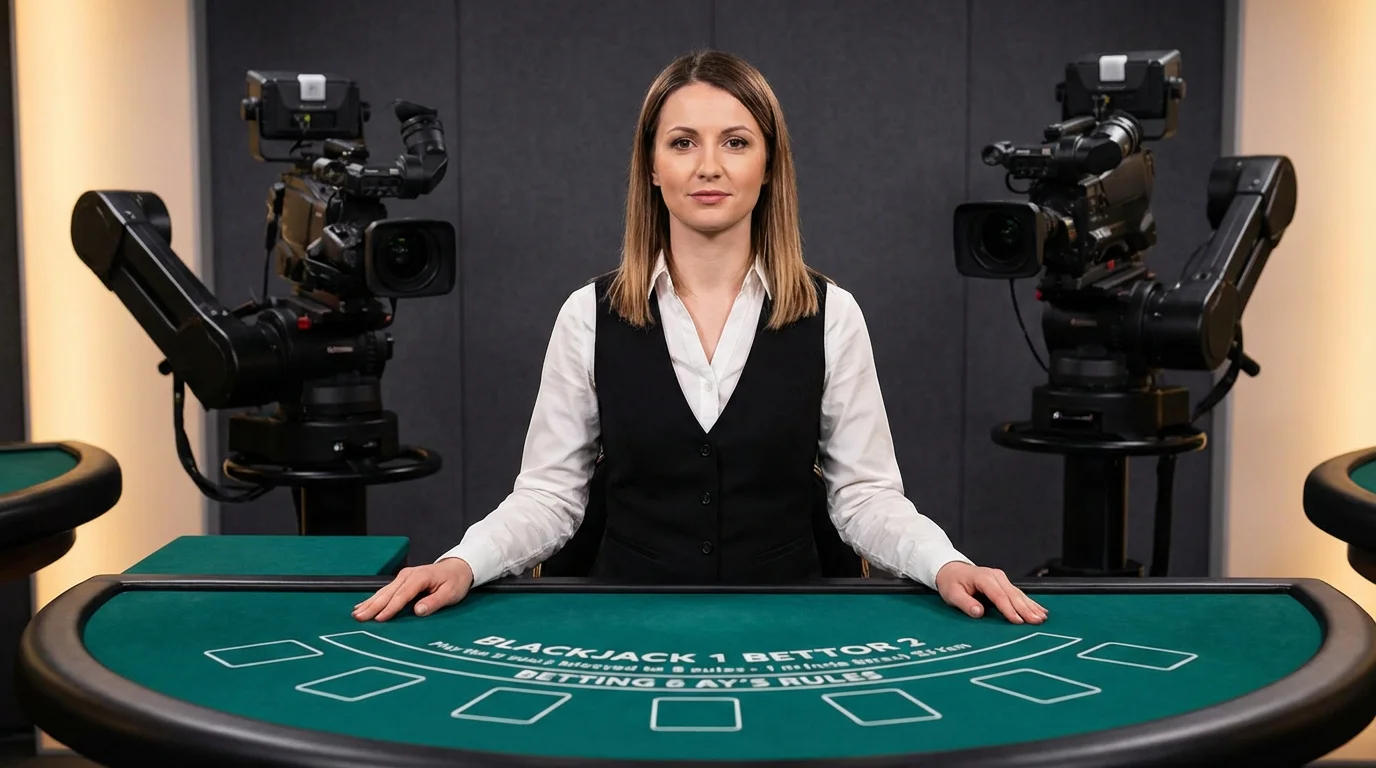
Live casino is the fastest-growing segment of the UK online gambling market. Evolution Gaming dominates the space with studios across Europe, but Pragmatic Play Live and Playtech have expanded aggressively. Beyond the classics — live blackjack, live roulette, live baccarat — the category now includes game show formats like Crazy Time, Monopoly Live, and Deal or No Deal. These combine a live presenter with RNG-powered bonus rounds, creating a hybrid entertainment product that trades mathematical edge for spectacle. The RTPs on game shows typically sit between 94% and 96%, comparable to slots, but the experience skews far more towards entertainment than strategic play.
Video Poker, Scratch Cards and Specialty Games
Everything that does not fit neatly into the three big categories lands here. Video poker deserves special mention because it offers some of the highest RTPs in any online casino — Jacks or Better with optimal play returns 99.54%, which is better than almost any slot and competitive with blackjack. The catch is that "optimal play" means memorising a hold strategy for every possible hand, which most casual players will not do.
Scratch cards are the opposite end of the spectrum: instant-reveal outcomes with no decisions, no strategy, and RTPs that typically range from 60% to 85% — among the worst in any casino. Keno operates on similar maths, with house edges often exceeding 20%. These games exist because some players want an immediate result without any pretence of skill or deliberation. They serve that purpose efficiently, if expensively.
Blackjack
House edge: 0.5% with basic strategy. Speed: 50–80 hands per hour. Skill factor: high — player decisions directly affect the edge.
Roulette
House edge: 2.7% on European tables. Speed: 30–40 spins per hour. Skill factor: none — every bet carries the same mathematical edge.
Baccarat
House edge: 1.06% on Banker bet. Speed: 40–60 hands per hour. Skill factor: minimal — one decision per hand, no strategy required.
Understanding RTP, House Edge and Volatility
Every casino game is a negative-expectation proposition — the question is how negative. Whether you are spinning a slot, playing a hand of blackjack, or watching a roulette ball bounce across 37 pockets, the maths ensures the operator retains a fraction of every pound wagered over time. That fraction is the house edge, and its inverse — what gets returned to players — is the Return to Player percentage. These are not suggestions or averages that clever play can overcome. They are structural properties of the game itself, baked into the rules and the pay tables.

Understanding these numbers will not help you win any individual session. What they will help you do is avoid games that are quietly draining your bankroll at twice the rate of alternatives sitting in the same lobby. A player who understands that a 94% RTP slot costs them twice as much per pound wagered as a 97% RTP slot is making a fundamentally different decision than a player who picks games based on theme or graphics.
What Return to Player (RTP) Tells You
RTP is a percentage, not a promise. When a slot advertises a 96.5% RTP, it means that over millions of spins — a sample size no individual player will ever achieve — the game is designed to return £96.50 for every £100 wagered. The remaining £3.50 is the house edge. That calculation plays out across the entire player population over the life of the game. Your individual session might return 200% of your wagers, or 0%. The RTP tells you nothing about what happens in the next hundred spins. It tells you everything about what happens over the next hundred million.
Published RTPs are theoretical figures derived from the game's pay table and mechanics, verified by independent testing houses before the game goes live. They are not observed averages from your specific session, and they do not adjust in real time. A game with a 96% RTP does not "owe" you a win after a losing streak. Each spin is independent, generated by a random number generator that has no memory of previous outcomes.
Volatility — Why Session Results Vary Wildly
Two slots with identical RTP can drain your bankroll at completely different speeds. That is volatility in action. A low-volatility slot distributes its returns in frequent, small payments — you win often, but rarely win big. A high-volatility slot does the opposite: long stretches of losses punctuated by large, infrequent payouts. Both arrive at the same RTP given enough spins, but the journey looks nothing alike.
For practical purposes, volatility determines how much bankroll you need to survive a session. A high-volatility slot with a 96% RTP might require 500 spins before its return profile starts resembling anything close to 96%. Play 50 spins on that game, and you could easily be up 300% or down 80% — neither result tells you anything meaningful about the game's long-term maths. Low-volatility games are more predictable per session but offer less potential for large wins. Neither is inherently better; they are different risk profiles for different types of player and different bankroll sizes.
Return to Player (RTP) — the theoretical percentage of total money wagered on a game that is paid back to players over time. Expressed as a percentage (e.g., 96%), it represents the mathematical inverse of the house edge. An RTP of 96% means the house edge is 4%.
Worked example: £100 wagered on a 96% RTP slot vs 99.5% RTP blackjack
STEP 1 — Identify the house edge
Slot: 100% - 96% = 4% house edge
Blackjack (basic strategy): 100% - 99.5% = 0.5% house edge
STEP 2 — Calculate expected loss per £100 wagered
Slot: £100 x 0.04 = £4.00 expected loss
Blackjack: £100 x 0.005 = £0.50 expected loss
STEP 3 — Compare the cost
The slot costs you eight times more per £100 wagered than blackjack played with basic strategy. Over £10,000 in total wagers — a figure a regular player can reach in a few weeks — that difference is £400 vs £50.
How to Start Playing Casino Games for Real Money
The distance between creating an account and placing a real bet is about four minutes. That speed is intentional — operators want the path from registration to first deposit to be frictionless. Which is precisely why you should slow down and treat those four minutes as a series of deliberate decisions rather than a conveyor belt to a bet slip.
Step one is choosing where to play, and the only non-negotiable criterion is a valid UK Gambling Commission licence. Every UKGC-licensed operator displays its licence number in the footer of its website, and you can verify it directly on the Gambling Commission's public register at gamblingcommission.gov.uk/public-register. If the licence number is missing, or if the site is licensed only by a jurisdiction like Curacao or Anjouan, walk away. The protections available to UK players — fund segregation, dispute resolution, mandatory responsible gambling tools — exist only under UKGC regulation.
Step two is registration. You will provide your name, date of birth, address, email, and phone number. UKGC rules require operators to verify your age and identity before you can withdraw, and many now run verification checks before allowing deposits. This is not bureaucracy for its own sake — it is a legal requirement designed to prevent underage gambling and money laundering. Have a photo ID and a recent utility bill or bank statement ready.
Step three — and this is the one most players skip — is setting your responsible gambling limits before you deposit. Every UKGC-licensed site must offer deposit limits (daily, weekly, monthly), loss limits, and session time reminders. Set them during registration, not after your first losing session. A deposit limit is easy to lower and deliberately slow to raise, which is exactly the asymmetry you want.
Step four is depositing. UK casinos accept debit cards (Visa, Mastercard), PayPal, Skrill, Neteller, Paysafecard, and bank transfers. Credit card gambling has been banned in the UK since April 2020. Choose a payment method with withdrawal capability — some deposit-only methods force you to use an alternative for cashouts, which adds delay. Check the minimum deposit (typically £10) and whether accepting a welcome bonus is mandatory or optional.
Step five is selecting a game. If this guide has done its job, you already know the difference between a 94% RTP slot and a 99.5% RTP blackjack table. Start with a game you understand, at stakes you can afford to lose entirely, and treat the first session as an orientation rather than an attempt to generate profit.
Before your first real-money session
- Verify the operator holds a current UKGC licence — check the number on the Gambling Commission's public register.
- Set a deposit limit before funding your account. Daily and weekly limits are available at every licensed site.
- Read the bonus terms in full. Check the wagering requirement multiplier, game contribution weights, time limits, and maximum bet restrictions.
- Choose a payment method that supports both deposits and withdrawals to avoid delays when cashing out.
- Review the withdrawal policy: processing times, minimum withdrawal amounts, and any pending period during which you can reverse a cashout.
Casino Bonuses — What UK Players Actually Get
A bonus is never free money — it is a conditional offer with maths attached. Every welcome bonus, every free spins package, every cashback deal comes with terms that determine whether you will ever see a penny of it in your bank account. The marketing department writes the headline. The terms and conditions page writes the reality. If you take only one thing from this section, let it be this: read the terms before you accept anything.
The UK regulatory landscape around bonuses has shifted considerably. Since January 2026, the Gambling Commission has capped wagering requirements on bonus funds at a maximum of ten times the bonus amount and banned mixed product promotional offers. This is a significant departure from the era of 40x and 50x wagering requirements that effectively made most bonuses impossible to convert into withdrawable cash. The new rules make bonuses more transparent, but they do not make them gifts — they remain marketing tools designed to extend play.
Welcome Bonuses, Free Spins, and Cashback
Three bonus structures dominate UK casinos, and each works differently. A welcome bonus — typically a matched deposit offer — gives you bonus funds equal to a percentage of your first deposit. A "100% match up to £100" means depositing £100 gives you £100 in bonus funds, bringing your total playable balance to £200. The bonus portion is not withdrawable until you meet the wagering requirement.
Free spins are awarded either as part of a welcome package or as standalone promotions. They let you spin a specific slot a set number of times at a predetermined stake, and any winnings are credited as bonus funds — again, subject to wagering requirements. The critical distinction is between wager-free spins (where winnings are immediately cashable) and conditional spins (where winnings must be wagered). Wager-free spins are genuinely valuable. Conditional spins with a 10x wagering requirement are worth considerably less than their face value.
Cashback bonuses return a percentage of your net losses over a defined period — typically 5% to 20%. The catch is whether the cashback is paid as real cash (immediately withdrawable) or as bonus credit (subject to wagering). Real-cash cashback is the most player-friendly bonus type because it has no strings attached beyond the loss condition itself. Bonus-credit cashback is just another wagering requirement in disguise.
How Wagering Requirements Eat Into Your Bonus
A 10x wagering requirement on a £50 bonus means £500 in total bets before you can withdraw any bonus-derived winnings. Under the previous regime, a 40x requirement on the same bonus would have meant £2,000 in bets — and at a 96% RTP slot, the expected loss during that wagering period would have been £80, exceeding the bonus value itself. The new UKGC cap at 10x makes the maths more favourable, but it still costs you.
Here is how it works in practice. You deposit £50 and receive a £50 bonus with a 10x wagering requirement. You need to wager £500 (10 x £50) before the bonus converts to cash. If you play a 96% RTP slot, your expected loss during that wagering period is £500 x 0.04 = £20. That means the £50 bonus has a theoretical net value of £30 after wagering costs. If you play blackjack with a 99.5% RTP and it contributes 100% to wagering — check the terms, because many operators weight table games at 10% or less — your expected loss is only £2.50, making the bonus worth £47.50 in net value.
Game contribution weighting is the hidden variable. Slots almost universally contribute 100% to wagering requirements. Blackjack might contribute 10%, roulette 20%, and some games are excluded entirely. If blackjack contributes only 10%, that £500 wagering requirement becomes £5,000 in blackjack bets to clear the same bonus — and suddenly the maths changes dramatically.
WARNING
Always check the wagering requirement, game contribution weights, time limit, and maximum bet per spin before accepting any casino bonus. A bonus that looks generous in the headline can have a negative expected value once the terms are factored in. If you are not willing to read the full terms and conditions, decline the bonus and play with your own deposited funds — you will retain full withdrawal freedom.
Is It Safe? UKGC Licensing, RNG and Fair Play
The UK Gambling Commission does not hand out licences casually. Obtaining and maintaining a UKGC operating licence requires operators to meet standards on financial stability, technical integrity, social responsibility, and anti-money laundering compliance. Those standards are not static — the Commission revises its Licence Conditions and Codes of Practice regularly, and operators that fail inspections face fines, licence suspensions, or revocation. In the year to March 2025, the UKGC's enforcement actions included penalties totalling millions of pounds against operators found to have failed in their social responsibility and AML obligations.
For players, the practical question is simple: is a UKGC-licensed casino safe to deposit money into? The answer is yes, with a level of protection that is among the strongest in any regulated gambling market globally. But "safe" does not mean "guaranteed to win" or "immune to poor experiences." It means the game outcomes are genuinely random, your funds are protected if the operator goes insolvent, and you have a formal dispute resolution path if something goes wrong.
What a UKGC Licence Guarantees
A UKGC licence number is the single most important thing to check before depositing at any online casino. That licence guarantees several specific protections. First, fund segregation: operators must hold player funds separately from business operating funds, ensuring that if the company enters administration, player balances are protected. The level of protection varies — some operators hold funds in a completely separate trust account, while others use a medium or basic protection level — but all UKGC licensees must disclose their approach.

Second, dispute resolution. If you have a complaint that the operator cannot resolve internally, UKGC-licensed casinos must direct you to an approved Alternative Dispute Resolution provider. This is a free, independent process. Third, advertising standards: operators cannot target minors, must present bonus terms clearly, and since May 2025 must obtain granular per-product and per-channel opt-in consent before sending marketing communications. Fourth, Know Your Customer procedures require identity verification before withdrawal processing, which protects both the player and the integrity of the platform.
Since February 2025, remote operators have been required to conduct financial vulnerability checks when a customer's net spend exceeds £150 in a rolling 30-day period. This is a meaningful intervention designed to identify players who may be spending beyond their means, and it is a requirement that exists only in UKGC-regulated markets.
How RNG Certification Keeps Games Fair
Random number generators are tested before deployment — and then audited continuously. Every game offered by a UKGC-licensed casino must use an RNG that has been certified by an accredited testing laboratory. The major certification bodies include eCOGRA, iTech Labs, and Gaming Laboratories International. These organisations test the RNG's statistical output against expected distributions, verify that results are unpredictable and non-repeatable, and ensure that the published RTP matches the game's actual performance across a statistically significant sample.
What players can verify themselves is limited but meaningful. Look for a testing certificate or seal on the casino's website — eCOGRA publishes monthly payout reports for operators that carry its seal. Check the game's info screen for its published RTP; reputable providers like NetEnt, Pragmatic Play, and Evolution Gaming display this prominently. If an operator or game provider does not disclose RTP figures, that is a red flag worth taking seriously.
UKGC-LICENSED CASINO
Player funds held separately from operating accounts. Independent dispute resolution through approved ADR providers at no cost to the player. Games tested and certified by accredited labs (eCOGRA, iTech Labs, GLI). Financial vulnerability checks required when net spend exceeds £150 in 30 days. Marketing requires per-product, per-channel opt-in consent. Self-exclusion available through GamStop covering all UKGC-licensed operators. Wagering requirements on bonuses capped at 10x since January 2026.
UNLICENSED OFFSHORE CASINO
No fund segregation requirement — player deposits may be mixed with business funds. No formal dispute resolution: if the operator refuses to pay, your only option is a complaint to a foreign regulator with no obligation to act. Game fairness unverifiable — no mandatory RNG certification by recognised testing bodies. No financial vulnerability or affordability checks. No marketing restrictions. No access to GamStop or UK self-exclusion schemes. No cap on wagering requirements — 50x, 60x, or higher is common.
Deposits, Withdrawals and Getting Your Money
The way money moves in and out of a casino account matters more than most players realise. Depositing is almost always instant and painless — operators have no incentive to slow down the process of taking your money. Withdrawals are where friction appears, and understanding the timeline and method differences before you deposit will save you frustration later.
UK online casinos accept several payment methods, each with different characteristics. Debit cards (Visa and Mastercard) are the most widely accepted: deposits are instant, withdrawals take one to five business days depending on the operator and your bank. Credit cards have been banned for gambling transactions in the UK since April 2020, so do not expect that option.
E-wallets — PayPal, Skrill, and Neteller — offer the fastest withdrawal times. PayPal withdrawals at well-run operators process within a few hours, often under four. Skrill and Neteller are similarly fast. The advantage of e-wallets is that the casino sends funds to your e-wallet account rather than directly to your bank, which typically eliminates the bank processing delay. The disadvantage is that some bonus offers exclude e-wallet deposits, so check the terms before choosing this route.
Paysafecard is a prepaid voucher option that allows deposits without sharing bank or card details. It is deposit-only — you cannot withdraw to a Paysafecard voucher, so you will need an alternative withdrawal method on file. Bank transfers work for larger amounts but are the slowest option, with withdrawals typically taking three to five business days.
Across all methods, withdrawal processing involves two stages: the operator's internal processing time (during which your request sits in a pending queue) and the payment provider's transfer time. The pending period varies by operator — some process within hours, others impose a 24 to 72-hour pending window. During this window, some casinos offer a "reverse withdrawal" option that lets you cancel the cashout and return the funds to your playable balance. If you are serious about cashing out, avoid operators that make reversal too easy. KYC verification is required before your first withdrawal, and submitting documents proactively during registration eliminates the most common cause of withdrawal delays.
Fastest UK withdrawal method: e-wallets — typically under 4 hours at top-rated sites. Debit cards take 1–5 business days. Bank transfers are slowest at 3–5 days. Submit KYC documents at registration, not at first withdrawal.
Responsible Gambling — Tools That Keep You in Control
Every UKGC-licensed casino must offer deposit limits, session timers, and self-exclusion. These are not optional features that operators provide out of goodwill — they are licence conditions, and failure to implement them properly results in regulatory action. The question is not whether the tools exist. The question is whether players use them, and the evidence suggests that when they do, they work.

Deposit limits are the simplest and most effective tool. You set a maximum amount you can deposit per day, per week, or per month. Reductions take effect immediately. Increases are subject to a mandatory cooling-off period — typically 24 hours for daily limits and 7 days for weekly or monthly limits. This deliberate asymmetry is designed to prevent impulsive increases during a losing session. From June 2026, all online casinos operating under UKGC licences will be required to prompt players to set a deposit limit before their first deposit and to remind them to review their limits every six months.
Session time limits and reality checks serve a different purpose. A reality check is a pop-up notification that appears at intervals you choose — every 30 minutes, every hour — showing you how long you have been playing and your net position. It interrupts the flow of play just long enough to make you conscious of time and money spent. It is a small friction, but for many players, it is the moment they decide to log off.
Self-exclusion is the strongest measure. Site-level self-exclusion locks you out of a single operator for a period you choose, typically six months to five years. GamStop — the UK's multi-operator self-exclusion scheme — locks you out of every UKGC-licensed gambling site simultaneously. Registration is free and can be done online at gamstop.co.uk. Once registered, you cannot reverse the exclusion until the minimum period has elapsed, and even then, re-registration requires a deliberate process.
If gambling is causing financial, emotional, or relationship harm, GamCare provides free support and counselling. Their helpline is available at gamcare.org.uk or by phone on 0808 8020 133. The National Gambling Helpline is confidential and available 24 hours a day, seven days a week. Using these tools is not a sign of weakness. It is the most rational decision a player can make when the maths of the game stops being the only thing working against them.
Frequently Asked Questions
What casino game has the best odds of winning?
Blackjack played with basic strategy offers the best odds of any widely available casino game, with a house edge as low as 0.5% depending on the specific rule set. That translates to an RTP of 99.5%. The baccarat Banker bet comes second at 98.94% RTP (1.06% house edge, before the standard 5% commission on wins). European roulette sits at 97.3% RTP on all bets, dropping to an effective 98.65% on even-money bets if you play French roulette with the la partage rule. Video poker variants like Jacks or Better can reach 99.54% RTP with optimal hold strategy. Among slots, the best RTPs rarely exceed 97%, and most fall between 94% and 96%. The general pattern is clear: games that involve player decisions tend to offer better odds than games of pure chance.
How do wagering requirements work on casino bonuses?
A wagering requirement is a multiplier that determines how much you must bet before bonus funds or bonus-derived winnings become withdrawable. Since January 2026, the UKGC has capped wagering requirements at 10x the bonus amount. So if you receive a £50 bonus with a 10x requirement, you must place £500 in total bets before you can withdraw. During those bets, the house edge applies — on a 96% RTP slot, your expected loss over £500 in wagers is £20, reducing the effective value of the £50 bonus to roughly £30. Game contribution weights also matter: slots typically contribute 100% towards wagering, while blackjack may contribute only 10%, meaning you would need to bet £5,000 at blackjack tables to clear the same requirement. Always check the time limit — most bonuses expire within 7 to 30 days — and the maximum bet per spin allowed during wagering, which is usually £5 or less.
Are online casino games rigged or fair?
At UKGC-licensed casinos, online games are fair. Every game uses a certified random number generator that produces statistically unpredictable results. These RNGs are tested and certified by independent laboratories — eCOGRA, iTech Labs, and Gaming Laboratories International are the most prominent — before deployment and are subject to ongoing audits. The UKGC requires operators to use only certified games, and operators that fail technical integrity checks face licence suspension or revocation. Players can verify fairness by checking the game's published RTP (displayed in the game info or help screen), looking for certification seals on the casino's website, and confirming the operator's UKGC licence status on the Gambling Commission's public register. None of this applies to unlicensed offshore casinos, where there is no regulatory oversight of game fairness and no independent verification of RNG integrity.
The Numbers Don't Lie — But Neither Should You
Knowing the house edge is the easy part. The maths of casino games is public, fixed, and frankly not that complicated. A 4% edge means you lose £4 per £100 wagered on average. A 0.5% edge means you lose 50p. These are facts, not opinions, and they do not change because you are feeling lucky, because you are on a winning streak, or because you read about a strategy in a forum.
The harder part — the part that no guide can fully prepare you for — is knowing yourself as a player. Do you chase losses? Do you increase your bets when you are down, convinced the next spin will turn things around? Do you set a deposit limit and then find yourself trying to raise it at midnight? These are not mathematical questions. They are behavioural ones, and they matter more than any RTP figure because the house edge only predicts what happens over thousands of bets. Your behaviour determines whether you reach those thousands of bets with your bankroll and your wellbeing intact.
The UK regulatory framework — the UKGC licence, the deposit limits, the mandatory self-exclusion options, the new vulnerability checks and bonus caps — exists to create a safer environment for real-money play. But regulation is a safety net, not a substitute for personal responsibility. The tools are there. The information is public. The maths is clear. What you do with all of it is the only variable the house cannot control.
Play informed. Play within limits you set when you are calm and clear-headed. And if the entertainment value of the game ever becomes secondary to the need to recover losses, stop. That is not a moral judgement. It is the single most rational decision available to any casino player, and it costs nothing.