Best Non GamStop Casino UK 2026
Loading...
- Blackjack Is the Only Casino Game Where Your Decisions Matter Most
- Blackjack Rules for UK Online Play
- Basic Strategy — The Mathematically Optimal Play
- Blackjack Variants Available in UK Online Casinos
- House Edge by Rule Set — Where to Find the Best Odds
- Common Blackjack Mistakes That Cost UK Players Money
- Why the Best Blackjack Players Still Lose Sessions
Blackjack Is the Only Casino Game Where Your Decisions Matter Most
Blackjack gives skilled players a house edge under 0.5% — no other widely available casino game comes close. Slots operate at 3–6% in the house’s favour. Roulette sits at 2.7% on its best variant. Baccarat manages 1.06% on the banker bet if you ignore ties. But blackjack, played with basic strategy on a favourable rule set, can bring the edge down to 0.28%. That gap is not trivial. Over 1,000 hands at £10 per hand, the difference between a 0.5% and a 3% house edge is £250 in expected losses.
What makes blackjack unusual is that the house edge is not fixed by the game — it is fixed by the player. Every hand presents decisions: hit, stand, double down, split. Each decision has a mathematically optimal answer, and deviating from that answer increases the house edge. A player who relies on intuition or gut feeling rather than basic strategy typically gives the casino an edge of 2–4%, which puts blackjack on par with roulette. The game rewards knowledge. Play correctly and you are playing the lowest-edge table game in the casino. Play badly and you are donating the difference to the operator.
This guide covers every dimension of real-money blackjack that matters to UK players: the rules as they apply on UKGC-licensed platforms, the basic strategy that defines optimal play, the variants you will encounter online, and the specific rule combinations that produce the best and worst odds. It also covers the mistakes that cost players the most and the reality of what variance looks like even when you play perfectly.
Blackjack Rules for UK Online Play
The objective of blackjack is not to get 21. That is a common misstatement that leads directly to bad play. The objective is to beat the dealer’s hand without exceeding 21. Sometimes that means standing on 13 because the dealer is showing a 6 and is likely to bust. Understanding this distinction — that you are playing against the dealer’s probable outcome, not chasing a magic number — is the foundation on which everything else in this guide rests.
UK online blackjack follows standard international rules with some regional variations in dealer procedure and available actions. The core mechanics are consistent across platforms: the game uses one to eight standard 52-card decks, cards are dealt from a virtual shoe, and the RNG shuffles the deck after every hand in most digital versions. Live dealer blackjack uses a physical shoe, typically with eight decks, and may deal multiple hands before reshuffling.
Card Values, Dealing Procedure, and Naturals
Aces count as 1 or 11, at the player’s advantage. Face cards — kings, queens, jacks — are worth 10. Every other card is worth its face value. A hand’s total is the sum of its card values. If an ace is counted as 11 without the hand exceeding 21, the hand is called “soft” — soft 17 means ace plus 6. If counting the ace as 11 would bust the hand, it reverts to 1, making the hand “hard.”
The deal begins with each player receiving two cards face-up. The dealer receives one card face-up (the upcard) and one face-down (the hole card). In European-style games common on UK online platforms, the dealer may not receive the hole card until all players have acted — this is known as the “no hole card” or “no peek” rule, and it has a measurable effect on strategy and house edge.
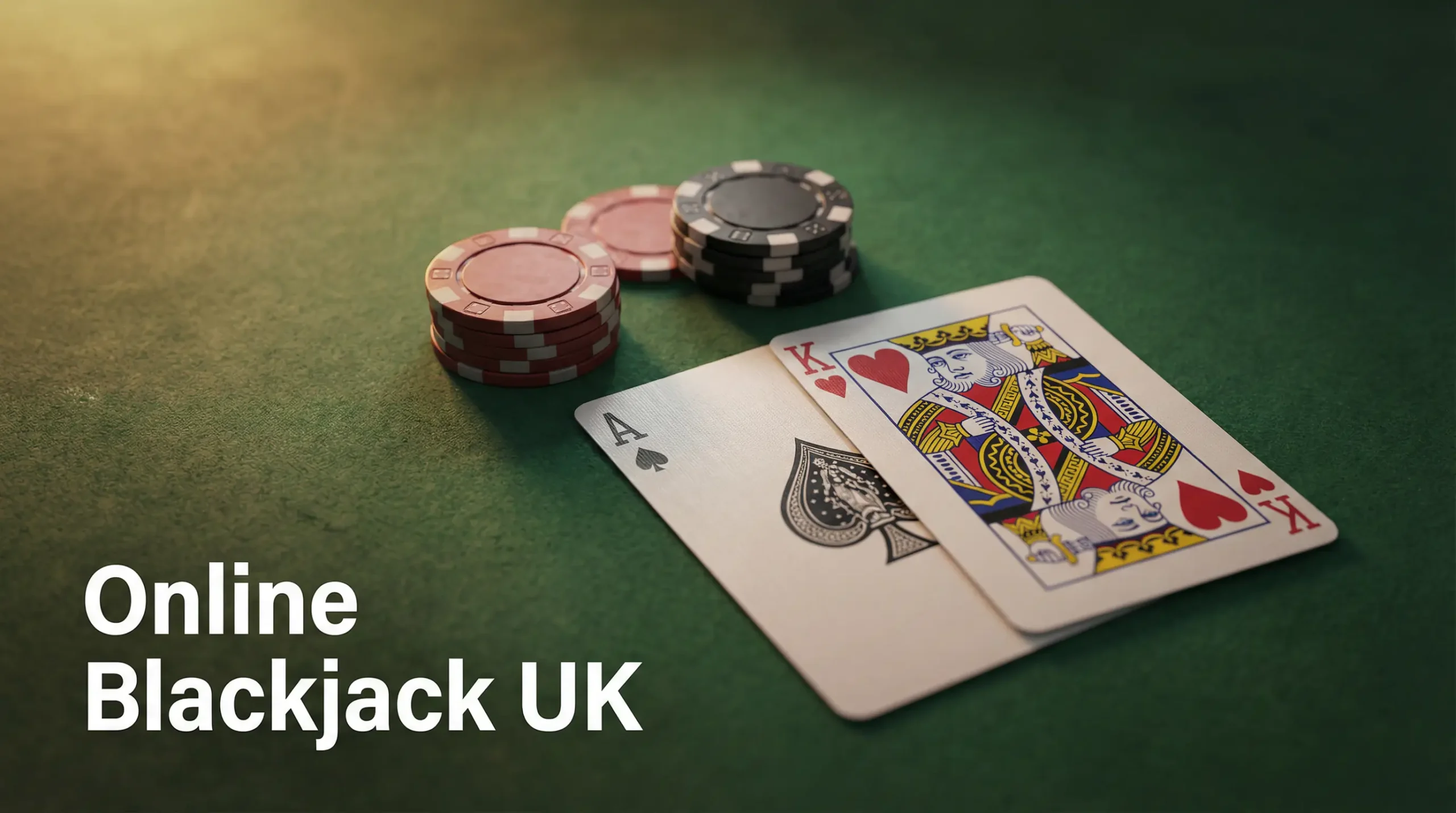
A natural blackjack — an ace plus any 10-value card dealt as the initial two cards — pays 3:2 on most UK tables. Some tables offer 6:5 on naturals instead, which increases the house edge by roughly 1.4%. This single rule change has a larger impact on the odds than almost any other variation. If you see a 6:5 blackjack table, the mathematically sound response is to find a different table.
Hit, Stand, Double Down, Split — When and Why
After receiving your initial two cards, you have up to four actions available depending on the hand and the table rules.
Hit means taking another card. You can hit as many times as you like until you either stand or bust (exceed 21). Standing means keeping your current total and ending your turn. These two actions are available on every hand.
Doubling down means doubling your original bet and receiving exactly one more card. You cannot hit again after doubling. This action is most valuable when you hold 10 or 11 and the dealer shows a weak upcard, because the probability of drawing a 10-value card is higher than any other single value. Most UK online tables allow doubling on any two cards; some restrict it to totals of 9, 10, or 11.
Splitting is available when your first two cards are a pair. You place a second bet equal to your original, and each card becomes the start of a separate hand. You then play each hand independently. Aces are a special case: most tables allow only one additional card per split ace, and a 10-value card dealt to a split ace does not count as a natural blackjack — it pays even money rather than 3:2.
Some tables offer surrender, which allows you to forfeit half your bet and abandon the hand before taking any action. Late surrender — the most common form — is available after the dealer checks for blackjack. It is the correct play in specific situations, such as holding 16 against a dealer 10, where the expected loss from playing the hand exceeds 50% of the bet.
Basic Strategy — The Mathematically Optimal Play
Basic strategy is not a theory or a system — it is a solved game. Every possible combination of player hand versus dealer upcard has been computed through billions of simulated hands, and the optimal action for each scenario is known with mathematical certainty. Following basic strategy perfectly does not guarantee you will win any particular session, but it guarantees you are not making the house edge worse than it needs to be.
The strategy is built on probability. When you hold 16 and the dealer shows a 10, hitting feels suicidal — you will bust roughly 62% of the time. But standing is worse. If you stand on 16 against a dealer 10, the dealer will make 17 or better about 77% of the time, and you lose to all of it. Hitting gives you a 38% chance of improving or the dealer subsequently busting. The expected loss from hitting is smaller than the expected loss from standing. Basic strategy always selects the action with the lowest expected loss, or the highest expected gain.
The same logic explains why you always split aces and eights. Two aces as a single hand total either 12 (hard) or 2 (useless). Split them, and each ace starts a hand with a strong chance of drawing a 10-value card for a total of 21. Two eights make 16 — statistically the worst hand in blackjack. Split them, and each 8 starts a hand that can improve in multiple directions. In both cases, splitting converts a bad position into two reasonable ones.
Doubling down on 11 against a dealer 6 is another textbook case. You have a roughly 31% chance of drawing a 10-value card for 21, and the dealer’s 6 is the most bust-prone upcard in the deck (roughly 42% chance of busting). The combination of a strong draw and a weak dealer position makes doubling — risking twice the money — the mathematically superior action.
The full strategy chart covers hard totals, soft totals, and pairs against every possible dealer upcard. Memorising it takes effort, but the underlying principles are simpler: hit weak hands against strong dealer cards, stand on strong hands against weak dealer cards, double when you have the advantage, split when separation improves both hands. Most UK online casinos allow you to reference a strategy chart while playing — there is no rule against it, and using one is the single most effective way to reduce the house edge without any advanced technique.
Blackjack Variants Available in UK Online Casinos
Not all blackjack tables offer the same edge. The name on the table matters less than the rules printed underneath it, because small rule variations compound into significant differences in house advantage. A table labelled “Classic Blackjack” at one casino may have completely different rules from a “Classic Blackjack” table at another. The label is marketing; the rules are maths.
Classic vs European vs Atlantic City Rules
Classic blackjack in the UK online context typically means a game dealt from six or eight decks, with the dealer standing on all 17s, doubling allowed on any two cards, splitting up to three times, and a 3:2 natural payout. Under these conditions with perfect basic strategy, the house edge sits around 0.40–0.50%.
European blackjack usually refers to the “no peek” rule: the dealer does not check for blackjack before players act. If you double or split against a dealer ace and the dealer subsequently reveals blackjack, you lose your additional bet as well as your original. This rule increases the house edge by approximately 0.11%. European blackjack also commonly restricts doubling to hard totals of 9, 10, and 11, which adds another 0.09% or so. Combined, the typical European rule set produces a house edge between 0.55% and 0.65%.
Atlantic City rules are among the most player-friendly. They typically include the dealer peeking for blackjack (eliminating the no-peek penalty), late surrender, doubling on any two cards, and re-splitting up to four hands. With eight decks and these rules, the house edge can drop below 0.35%. These tables are less common on UK platforms than European variants, but they do appear — particularly from providers like Microgaming and Playtech.
The difference between the best and worst commonly available rule sets is roughly 0.3%. That sounds negligible, but over 500 hands at £10 per hand it amounts to £15 in additional expected loss — roughly the cost of one hand’s stake.
Live Dealer Blackjack — Side Bets and Multipliers
Live dealer blackjack adds a streaming video feed of a real dealer at a physical table. The core rules are the same as standard online blackjack, but the experience is substantially different. You see the cards dealt in real time, you can observe other players’ decisions, and there is a chat function that allows interaction with the dealer. For players who find RNG blackjack too clinical, the live format restores the social and visual elements of casino play.
Most live blackjack tables in the UK are produced by Evolution, Pragmatic Play Live, or Playtech. Evolution’s standard live blackjack tables typically use eight decks, the dealer stands on soft 17, and doubling is permitted on any two cards. The house edge on these tables, with perfect basic strategy, is approximately 0.50%.
Side bets are where live blackjack diverges from optimal play. Options like Perfect Pairs, 21+3, and Bet Behind are available on most live tables. These bets carry house edges ranging from 2% to over 10%, depending on the specific bet and the paytable. They add entertainment value but degrade your overall expected return. If your goal is to play the lowest-edge game available, ignore the side bets entirely.
Lightning Blackjack, an Evolution variant, adds random multipliers of up to 25x on winning hands. Each round, random card values are selected and assigned multipliers. If your winning hand contains multiplied cards, the payout scales accordingly. The catch is a 100% fee on each hand — you pay double your base bet to participate, which funds the multiplier pool. The theoretical RTP is 99.56%, but the variance is dramatically higher than standard blackjack. Lightning Blackjack is best understood as a hybrid between traditional blackjack and a lottery mechanic — it looks like blackjack, but the multiplier system changes the risk profile considerably.
House Edge by Rule Set — Where to Find the Best Odds
The house edge in blackjack swings from 0.28% to over 2% depending on rule combinations. That range is wider than most players realise, and it means that table selection is a strategic decision — not just a matter of aesthetics or seat availability.
The rules that have the largest individual impact on the house edge are, in order of magnitude: blackjack payout (3:2 vs 6:5 adds approximately 1.39%), number of decks (single deck vs eight decks adds roughly 0.57%), dealer hitting soft 17 vs standing (adds about 0.22%), and the availability of doubling after splits (removing it adds about 0.14%). Surrender, when available, reduces the edge by approximately 0.08% — a smaller factor, but still worth taking when offered.
The best realistic scenario on UK online platforms is a game with six or eight decks, dealer stands on soft 17, doubling on any two cards, doubling after splits allowed, and 3:2 blackjack payout. Under these rules with perfect basic strategy, the house edge sits between 0.35% and 0.45%. That is among the best odds available in any casino game, including baccarat’s banker bet.
The worst common scenario is an eight-deck game with dealer hits soft 17, no doubling after splits, no surrender, and a 6:5 natural payout. This configuration pushes the house edge above 2%, which is closer to roulette territory than to the blackjack most people imagine they are playing. The 6:5 payout alone accounts for more than half of that increase — a single rule change that negates most of the advantage you gain from learning basic strategy.
To identify the best-odds tables, check the game’s information or help screen before sitting down. UK-licensed platforms are required to display the rules and the theoretical RTP. A blackjack game with an RTP of 99.50% or above is running favourable rules. Anything below 99.00% suggests a rule combination that is working against you more than it needs to.
Common Blackjack Mistakes That Cost UK Players Money
Taking insurance is the single most profitable decision — for the casino. Insurance is offered when the dealer’s upcard is an ace. It costs half your original bet and pays 2:1 if the dealer has blackjack. The maths is unfavourable in virtually every scenario: in a six-deck game, the dealer has a 10-value card underneath roughly 30.8% of the time. For insurance to break even, that probability would need to be 33.3%. Over the long run, insurance costs you about 7.7% of the insured amount. Basic strategy says to decline it, always, with the sole exception of certain card-counting scenarios that do not apply in RNG online play.
Standing on soft 17 is another common error. Soft 17 (ace plus 6) looks like a reasonable hand, and many players instinctively protect it. But you cannot bust by hitting a soft 17 — the worst outcome is a hard total that may still be higher than 17. Hitting gives you a chance to improve to 18, 19, 20, or 21, while the downside is limited. Against a dealer upcard of 3 through 6, the correct play is to double. Against 7 through ace, the correct play is to hit. Standing is never optimal.
Mimicking the dealer’s strategy — hitting until 17 and standing regardless of the dealer’s upcard — is a surprisingly popular approach. It feels logical: if the dealer follows these rules and the house wins, surely copying the strategy works for the player too. It does not. The dealer’s edge comes from the fact that the player acts first. If both the player and the dealer bust, the player loses — the dealer does not have to play the hand. This asymmetry means that playing like the dealer produces a house edge of approximately 5.5%, which is ten times worse than basic strategy.
Chasing losses by increasing bet sizes after a run of losing hands is not a blackjack strategy — it is a betting system, and no betting system changes the house edge. Doubling your bet after a loss (the Martingale approach) does not recover losses in expectation; it merely concentrates your risk into fewer, larger bets. One extended losing streak — and streaks of 8 or 10 losses are entirely normal in blackjack — can exhaust your bankroll or hit the table limit. The correct bet sizing approach is to wager a consistent amount that your session bankroll can sustain for at least 100 hands.
Finally, ignoring the rules of the specific table you are playing is a mistake that encompasses all the others. Blackjack is not one game — it is a family of games with shared mechanics and different edges. Playing basic strategy designed for a dealer-stands-on-soft-17 game at a table where the dealer hits soft 17 will cost you extra money on specific hands. If the rules matter enough to change the house edge — and they do — they matter enough to read before you sit down.
Why the Best Blackjack Players Still Lose Sessions
A perfect strategy does not guarantee profits — it guarantees you are not making it worse. This distinction confuses players who assume that learning basic strategy converts blackjack into a money-making exercise. It does not. Even at a 0.35% house edge, the casino retains an advantage on every hand. Over a long enough series of hands, that edge will manifest as a net loss. The question is not whether you will lose, but how much and how slowly.
Variance is the reason perfect players lose sessions. In a typical 100-hand session of blackjack at £10 per hand, the expected loss with basic strategy is somewhere between £3.50 and £5.00 depending on the rules. But the standard deviation of results over 100 hands is roughly £115. That means your actual result on any given night could be anywhere from a £200 profit to a £250 loss, and both outcomes are statistically unremarkable. The expected loss is buried inside a range of outcomes so wide that it is essentially invisible in a single session.
This is precisely why bankroll management matters even for skilled players. A bad session is not evidence that you are playing incorrectly. A good session is not evidence that you have discovered a winning system. Both are normal fluctuations around a slightly negative expected value. The players who survive long enough to enjoy the game are the ones who understand that variance is a feature of every card game, not a problem to be solved.
The value of basic strategy is not that it turns blackjack profitable. The value is that it minimises the price of entertainment. A player using basic strategy at a 0.40% house edge is paying roughly 40p per hundred pounds wagered for the privilege of playing. A player ignoring strategy at a 3% edge is paying £3. Both players are gambling. One is paying seven times more for the same experience. Knowing the maths will not make you lucky, but it will ensure you are not paying more than you have to for every hand you play.