Best Non GamStop Casino UK 2026
Loading...
Video Poker — Where Strategy Meets RTP Above 99%
Full-pay video poker offers the highest RTP of any casino game — if you play optimally. That conditional clause is the entire story of video poker, a game that sits in a strange space between slots and table games, demanding more skill than the former while offering better returns than almost anything in the latter category. A full-pay Jacks or Better machine returns 99.54% with perfect strategy. A full-pay Deuces Wild variant returns 100.76% — a theoretical player edge that sounds too good to be true, and in practice, nearly is.
Video poker works on a simple premise: you are dealt five cards from a standard 52-card deck, you choose which cards to hold and which to discard, and the discarded cards are replaced with new ones from the remaining deck. Your final five-card hand is evaluated against a pay table, and you are paid accordingly. No dealer, no opponents, no bluffing. The only decisions that matter are which cards to hold — and those decisions have mathematically correct answers for every possible hand.
In the UK online casino market, video poker occupies a peculiar niche. It is rarely promoted, seldom featured in lobby banners, and almost never attached to bonus offers. The games exist, they are available, and they offer some of the best return rates in the building. Finding them requires intention. Playing them well requires study. Both efforts pay off.
Jacks or Better, Deuces Wild, and Other Variants
Each variant has a different pay table — and a different optimal strategy. Video poker is not a single game but a family of games that share the same five-card-draw mechanic while varying the pay tables, wild cards, and minimum qualifying hands. The strategic differences between variants are substantial enough that a strategy optimal for one variant will produce suboptimal results on another.
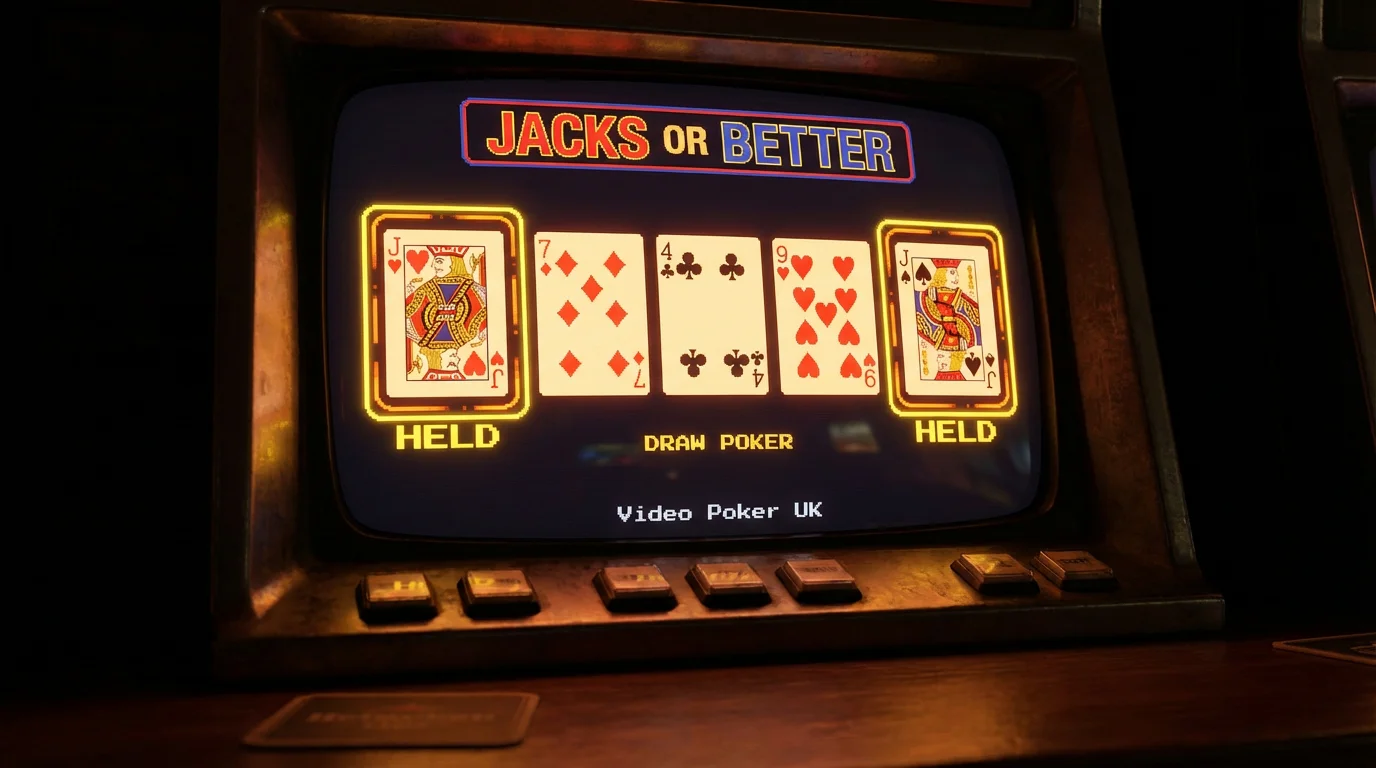
Jacks or Better is the baseline. The minimum paying hand is a pair of jacks or higher. The full-pay version (sometimes labelled “9/6” because it pays 9 coins for a full house and 6 for a flush per coin bet) returns 99.54% with optimal play. This is the variant most beginners should learn first, because its strategy is the simplest and translates most directly to other versions. The game is purely skill-based in the sense that no wild cards alter hand probabilities — what you see is what you calculate with.
Deuces Wild designates all four 2s as wild cards, substituting for any other card to form the best possible hand. The minimum paying hand is three of a kind (since pairs become much easier with four wild cards). A full-pay Deuces Wild machine returns 100.76% — one of the only casino games with a theoretical player edge. The catch: the optimal strategy is significantly more complex than Jacks or Better, with different hold decisions for hands containing zero, one, two, three, or four deuces. Errors are costly, and most players who attempt Deuces Wild without studying the strategy give back the theoretical edge and then some.
Bonus Poker is a Jacks or Better variant with enhanced payouts for four-of-a-kind hands, particularly four aces. The increased four-of-a-kind payouts are funded by reduced payouts on full houses and flushes, which makes the game slightly more volatile than standard Jacks or Better. The full-pay version returns approximately 99.17% with optimal play. The strategy is similar to Jacks or Better with minor adjustments to account for the enhanced four-of-a-kind value.
Double Bonus Poker pushes the four-of-a-kind bonuses further, paying 160 coins (versus 125 in Bonus Poker) for four aces at max bet. The trade-off is sharper reductions in full house and flush payouts. Full-pay RTP is approximately 100.17% — another theoretical player edge, but like Deuces Wild, achieving it requires precise strategy. The game is higher variance than Jacks or Better, with longer losing stretches between the lucrative four-of-a-kind payouts that drive the return above 100%.
Joker Poker adds a joker to the 52-card deck, creating a 53-card game with one wild. The minimum qualifying hand varies by version — some require kings or better, others two pair. Full-pay versions return approximately 100.64% with optimal play. Availability in UK online casinos is more limited than Jacks or Better or Deuces Wild.
Optimal Hold Strategy for Jacks or Better
The decision of which cards to hold is where your edge lives. Unlike slots, where you press a button and accept the outcome, video poker puts a meaningful strategic choice in your hands on every deal. The correct hold decision depends on your five initial cards and the pay table, and there is always one decision that maximises expected value.
The complete optimal strategy for Jacks or Better can be summarised as a ranked list of hand categories. When dealt your initial five cards, you compare your hand against the list from top to bottom and hold the first category that matches. The abbreviated hierarchy, from highest to lowest priority, is as follows: hold any made paying hand (pair of jacks or better through royal flush), except break a made hand only when holding four to a royal flush. Hold four to a straight flush. Hold four to a flush. Hold an open-ended straight draw. Hold a high pair (jacks or better). Hold three to a royal flush. Hold four to an inside straight with all four high cards. Hold a low pair (twos through tens). Hold four to an inside straight with three high cards. Hold two suited high cards. Hold three to a straight flush. Hold two unsuited high cards (prefer lowest two if three are present). Hold a single jack, queen, king, or ace. Discard everything else and draw five new cards.
The non-intuitive decisions are the ones that separate optimal play from average play. Holding a low pair over an open-ended straight draw is counterintuitive — the straight draw looks more promising visually — but the expected value of the pair (which can improve to two pair, three of a kind, full house, or four of a kind) exceeds the draw. Breaking a made flush to hold four to a royal flush feels reckless but is correct, because the expected value of the royal flush draw (driven by the 800-coin jackpot payout at max bet) exceeds the guaranteed flush payout.
These decisions add up. A player making perfect hold decisions on every hand achieves 99.54% RTP. A player making roughly correct decisions — holding obvious hands right but fumbling the marginal cases — might achieve 98.5% to 99.0%. That half-percent difference is entirely in the borderline hands: the low pairs held over straight draws, the three-to-a-royal-flush held over a made pair, the single high card held instead of discarding everything. The margin between good play and optimal play is narrow but worth capturing over thousands of hands.
How to Read a Video Poker Pay Table
The payout for a full house and a flush tells you almost everything about the game’s RTP. In Jacks or Better, the full-pay version is called “9/6” because it pays 9 coins for a full house and 6 for a flush per coin wagered. This specific pay table produces the 99.54% return. Reduce the full house payout by one coin to 8 (an “8/6” game), and the RTP drops to approximately 98.4%. Reduce both to 8/5, and you are playing at roughly 97.3%. The difference between a 9/6 game and an 8/5 game is 2.2% — an enormous gap in video poker terms, entirely determined by two lines of the pay table.
Before playing any video poker game, check the pay table. It is displayed on the machine’s screen, usually permanently visible or accessible through a help button. The critical numbers to verify are the full house and flush payouts. For Jacks or Better, accept nothing less than 9/6. For Bonus Poker, the target is 8/5 with the enhanced four-of-a-kind payouts. For Deuces Wild, the full-pay version pays 5 for four of a kind, 15 for five of a kind, 9 for a straight flush, and 25 for four deuces — deviations from these values indicate a reduced-pay version.
UK online casinos vary significantly in which pay tables they offer. Some carry full-pay versions. Others offer only reduced-pay tables that look identical to full-pay at a glance but cost the player 1% to 3% in expected return. The visual design of the game will be the same. The payout structure will not. The only way to tell is to read the numbers, which is why pay table literacy is the most important practical skill in video poker — more important even than memorising the hold strategy, because no strategy can overcome a bad pay table.
The Casino Game Nobody Talks About — But Should
Video poker sits in the corner of every casino lobby, quietly offering the best maths in the building. It is not promoted because promoting it would direct players toward the lowest-margin games on the platform. It is not popular because it lacks the visual spectacle of modern slots and the social energy of live dealer games. It demands study, which most recreational players are not interested in providing. And it rewards that study with a return rate that no other casino game can match.
For players willing to invest an hour learning the Jacks or Better hold strategy and five minutes verifying the pay table before playing, video poker offers a house edge under 0.5% — in a game that plays as fast as a slot and requires less mental effort than blackjack. The catch is that the game is solitary, the graphics are dated, and the experience is closer to solving a maths problem than to entertainment. If that trade-off works for you, video poker is the most rational choice in any UK casino lobby. If it does not, at least you now know what you are choosing to leave on the table.