Best Non GamStop Casino UK 2026
Loading...
The Appealing Lie of Roulette Betting Systems
Every roulette system promises control over chaos — none of them deliver. The appeal is immediate and visceral: follow a specific pattern of bet sizes, and you can recover your losses, lock in profits, or somehow tilt the odds in your favour. The Martingale doubles after losses. The Fibonacci follows a sequence. The d’Alembert increases by one unit. They all sound different. They all fail for the same reason.
Roulette is a game of independent outcomes. The ball has no memory. The wheel does not know your betting history or your current balance. Each spin produces a result drawn from an unchanging probability distribution — 37 pockets on European roulette, each equally likely — and no sequence of bets, however cleverly arranged, can change the expected value of those outcomes. Systems rearrange when and how much you bet. They cannot rearrange the maths.
This article examines the four most popular roulette betting systems, demonstrates why each one fails mathematically, and explains the specific danger that makes progressive systems worse than flat betting in practice.
Martingale, Fibonacci, d’Alembert, Labouchere — Analysed
Four systems, four ways to rearrange the same expected loss. Each system dictates how you adjust your bet size based on wins and losses. None of them changes the expected value of any individual bet, and none changes the cumulative expected value of a session. What they change is the distribution of possible session outcomes — the shape of the risk, not its magnitude.
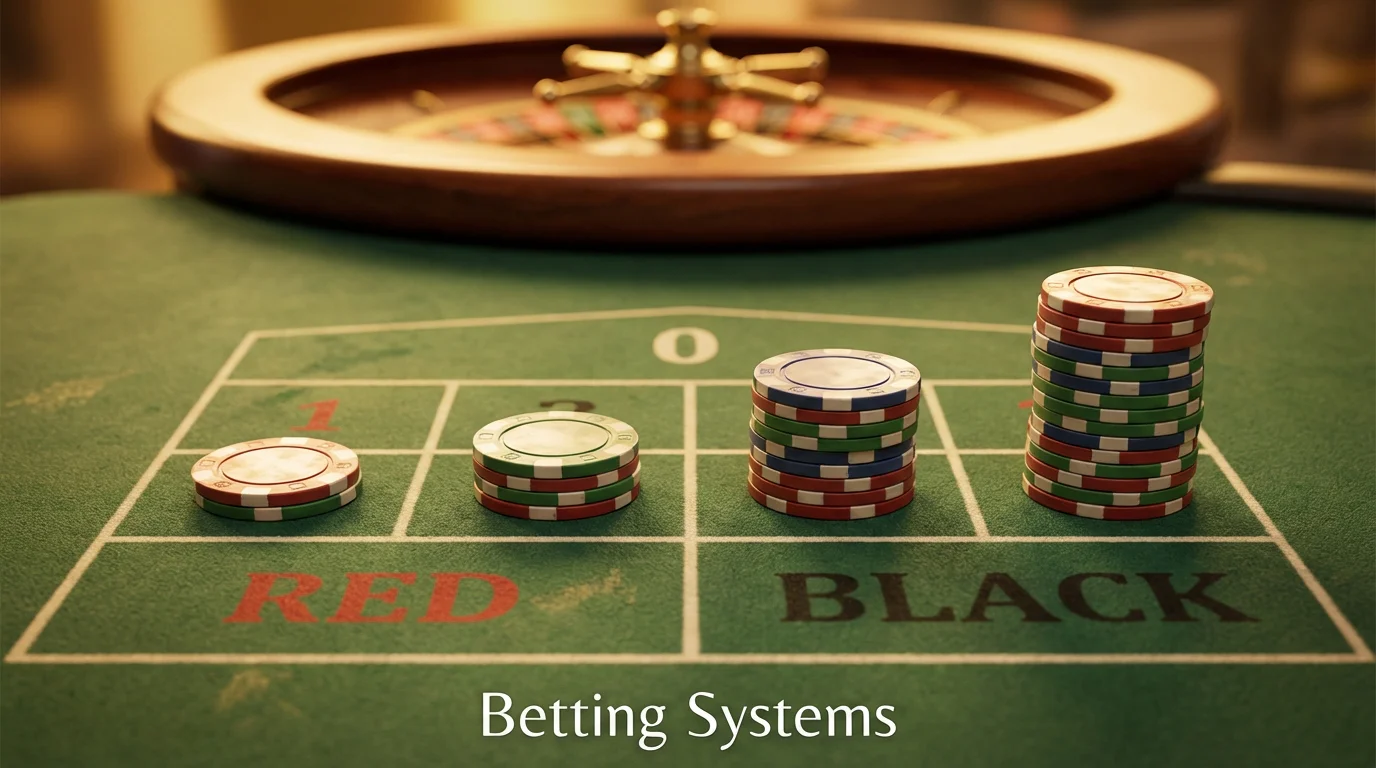
The Martingale is the most widely known and the most dangerous. The rule is simple: after every loss, double your bet. When you eventually win, the payout covers all previous losses plus one unit of profit. Start with £5 on red. Lose. Bet £10. Lose. Bet £20. Lose. Bet £40. Win. Your total outlay was £75 (5 + 10 + 20 + 40), and your return on the winning bet is £80 (£40 stake plus £40 profit), yielding a net gain of £5 — one base unit.
The system appears to guarantee profit because a win must eventually occur. This is technically true given infinite bankroll and no table limits. In reality, neither condition holds. A sequence of seven consecutive losses on an even-money bet (probability: approximately 1.3% on a European wheel) requires a bet of £640 just to recover from a £5 starting point. Ten consecutive losses, which occur roughly once in every 800 sequences, require £5,120. The system trades frequent small wins for rare catastrophic losses, and the expected value of those rare catastrophes exactly offsets the accumulated small gains.
The Fibonacci system uses the Fibonacci sequence (1, 1, 2, 3, 5, 8, 13, 21, …) to determine bet sizes. After a loss, you move one step forward in the sequence. After a win, you move two steps back. The progression is slower than the Martingale, which means the bet sizes escalate less aggressively and the bankroll survives longer in a losing streak. The trade-off is that recovering from deep losses requires multiple consecutive wins rather than a single one.
The slower escalation makes the Fibonacci feel safer than the Martingale, and in terms of session survival, it is — you are less likely to hit a table limit or drain your bankroll in a short losing run. But the expected value per unit wagered is identical. The system produces the same long-run loss as flat betting. It simply distributes that loss differently across sessions, creating a profile of many small wins and occasional moderate losses.
The d’Alembert is the gentlest of the progressive systems. After a loss, increase your bet by one unit. After a win, decrease by one unit. The theory, proposed by the 18th-century mathematician Jean-Baptiste le Rond d’Alembert, assumed that outcomes in games of chance tend toward equilibrium — that a loss makes a win more likely and vice versa. This assumption is false. Roulette outcomes are independent. The wheel does not compensate for past results.
The d’Alembert’s gentle progression makes it the least likely to produce catastrophic losses in a single session. It is also the least likely to produce dramatic recoveries. The system plods along, winning slightly more per unit during winning streaks and losing slightly more per unit during losing streaks, with a net expected value that matches flat betting over time.
The Labouchere (also called the cancellation system) is the most complex. The player writes a sequence of numbers — say, 1-2-3-4. Each bet is the sum of the first and last numbers in the sequence (1 + 4 = 5 units). A win removes both numbers from the sequence. A loss adds the bet amount to the end. The sequence is “complete” when all numbers are crossed out, at which point the player has theoretically gained a total equal to the sum of the original sequence (1 + 2 + 3 + 4 = 10 units).
The Labouchere is more flexible than the Martingale — you can shape the risk profile by choosing your starting sequence. A sequence of 1-1-1-1 produces slow, conservative play. A sequence of 3-5-7 escalates quickly. But flexibility in bet sizing does not create flexibility in expected value. The house edge operates on every individual bet regardless of how the bet was determined, and the sum of all those individual expected losses equals the total expected session loss. The Labouchere reshapes the journey. It does not change the destination.
Why No Bet Sequence Changes the House Edge
Expected value is multiplicative across independent events — the order and size of bets is irrelevant to the total expected loss. This is the mathematical principle that kills every betting system ever devised for roulette, and it can be stated simply: the expected loss on a series of bets equals the sum of the expected losses on each individual bet.
An even-money bet on European roulette has an expected value of -2.70% of the stake. If you bet £5, your expected loss is £0.135. If you then bet £10, your expected loss on that bet is £0.27. The total expected loss across both bets is £0.405 — exactly the same as if you had placed two £7.50 flat bets (total £15, expected loss £0.405). The sizes of the individual bets do not interact. Each one is an independent transaction with the house, and each one carries the same percentage disadvantage.
No rearrangement of bet sizes can change this. Doubling after a loss does not alter the probability of the next spin. Reducing after a win does not preserve a mathematical advantage that does not exist. The system dictates your bet size, but the house edge dictates your expected loss per pound wagered, and the house edge is constant — 2.70% on European roulette, on every spin, regardless of what happened before or how much you bet.
The persistent illusion that systems work comes from selective observation. Over short sequences, any system will appear to produce results — positive or negative — that seem to validate or invalidate it. A Martingale player who wins ten sessions in a row will believe the system works. The Martingale player who loses their entire bankroll on session eleven — a mathematically inevitable event given enough repetitions — provides the correction, but that correction happens to one player at a catastrophic scale rather than to many players at a tolerable scale. The stories of success circulate. The stories of ruin do not.
Table Limits and the Martingale Collapse
After seven consecutive losses, a £5 Martingale requires a £640 bet. After ten, it requires £5,120. These figures are not theoretical curiosities — they are the mechanical reality of exponential progression meeting the finite constraints of real play.
Every roulette table has a maximum bet. Online tables typically cap at £500 to £5,000 for even-money bets, depending on the operator and the specific table. A £5 Martingale hits a £500 limit after just seven consecutive losses, making recovery impossible — the system breaks not because the player runs out of money (though that may happen simultaneously) but because the table will not accept the required bet. At that point, the player has lost £635 in cumulative bets (5 + 10 + 20 + 40 + 80 + 160 + 320) and cannot place the £640 bet that would recover the sequence.
Seven consecutive losses on an even-money European roulette bet occur with a probability of approximately 1.3%. This means that in every 77 sequences, roughly one will result in a table-limit collapse. If you play 30 spins per hour and average a Martingale sequence length of 2.5 spins, you complete approximately 12 sequences per hour. Over an eight-hour playing day, you complete roughly 96 sequences. The probability of at least one catastrophic collapse in that day is approximately 72%. The system does not fail rarely. It fails predictably, reliably, and inevitably — the only uncertainty is when.
The Only System That Works Is Understanding the Odds
The house edge exists regardless of how you arrange your bets. No sequence of wagers can overcome a negative-expectation game. This is not a limitation of current betting systems that a future innovation might solve. It is a mathematical certainty, proven and reproven across centuries of probability theory.
The productive response to this reality is not despair — it is clarity. If you play roulette, choose European or French tables to minimise the house edge. Set a session budget that you can lose entirely without financial consequences. Bet flat at a stake that makes that budget last long enough to be entertaining. Accept that the expected outcome of every session is a loss, and judge the session by whether you enjoyed the experience, not by whether a system “worked.”
Systems are seductive because they offer the illusion of agency in a game that offers none. The wheel does not respond to patterns. The ball does not respect sequences. The only meaningful decision you make at a roulette table is how much money to bring and when to walk away. Everything between those two moments is probability running its course. The sooner you accept that, the more honestly you can evaluate whether the entertainment is worth the price.