

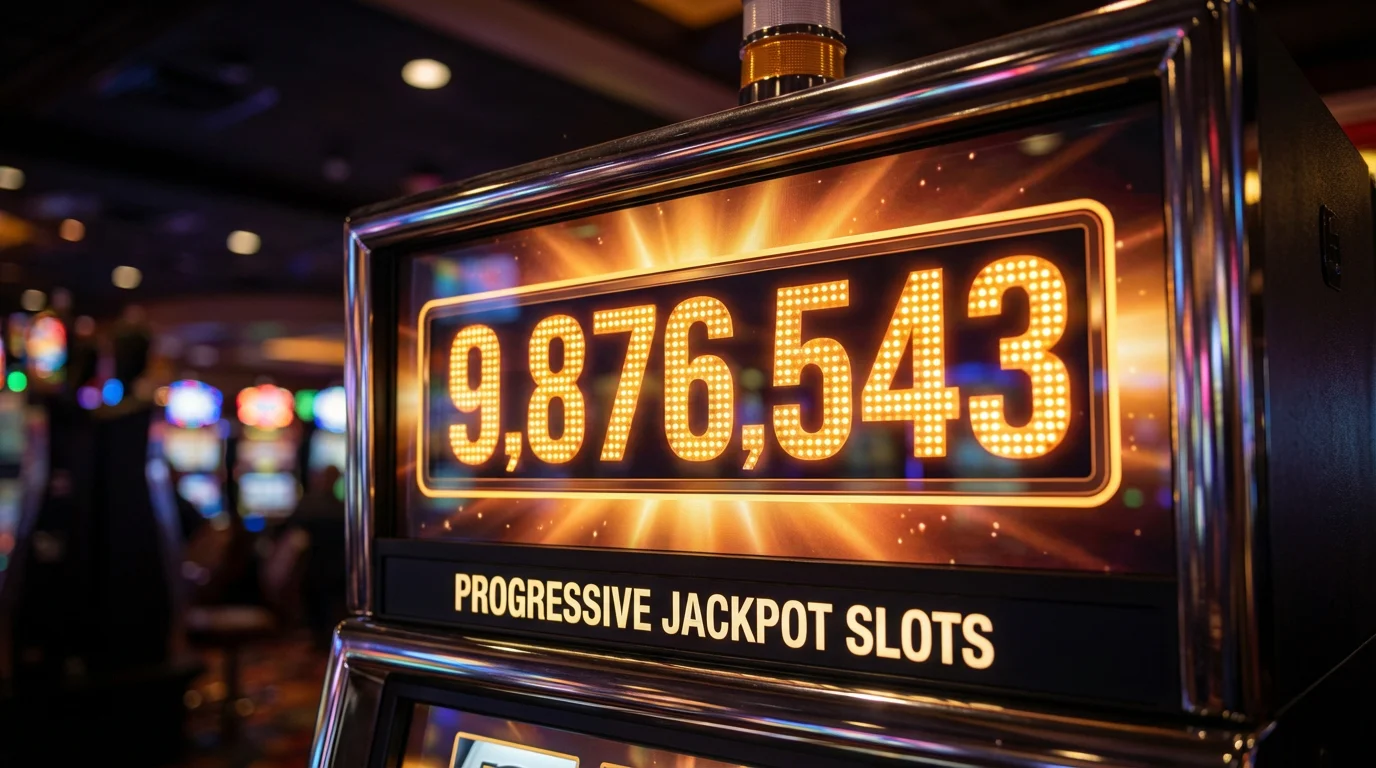
How Progressive Jackpots Reach Millions
Every bet on a progressive slot feeds a fraction into the jackpot pool. That mechanism — simple in principle, extraordinary in scale — is how online slots generate prize pools that reach into the millions of pounds. No single player funds the jackpot. Thousands of players across dozens or hundreds of casinos contribute simultaneously, each spin shaving off a small percentage of the wager and adding it to a shared prize that climbs until someone triggers it.
Progressive jackpots are the reason slot games occasionally make national news. The prizes are real. Mega Moolah has paid out individual jackpots exceeding £13 million. Mega Fortune once delivered a record-breaking €17.8 million to a single player. These numbers are verifiable, and the winners are actual people who placed actual bets.
But the flip side of those headlines rarely gets the same attention. Progressive slots carry lower base-game RTP than standard slots, the odds of hitting the top prize are astronomically small, and the contribution mechanism means every spin returns less to the player than the same bet on a non-progressive game. Understanding how the system works — mechanically and mathematically — is the only honest way to decide whether progressive jackpot slots deserve a place in your playing rotation.
Standalone vs Networked Jackpots — How Pools Grow
Networked jackpots pool bets across hundreds of casinos. That is the core mechanism behind the largest prizes in online gambling, and it works because the software provider — not the individual casino — manages the jackpot pool. When a player in Manchester spins Mega Moolah at one site and a player in Bristol spins it at another, both contributions flow into the same central pot. The provider (in this case, Microgaming) tracks the total, triggers the payout when conditions are met, and funds the prize from the pooled contributions.
The contribution rate — the percentage of each bet that feeds the jackpot — varies by game but typically ranges from 1% to 5% of the total wager. On a £1 spin, that means between 1p and 5p goes to the jackpot pool instead of being available for regular payouts. This is not deducted separately from your account; it is built into the game’s payout structure. The slot simply returns slightly less on non-jackpot outcomes to compensate.
Standalone progressive jackpots work differently. They are confined to a single casino or sometimes a single machine. Because only one set of players feeds the pool, these jackpots grow more slowly and reach lower peaks. A standalone progressive at a single online casino might top out in the tens of thousands rather than the millions. The trade-off is that standalone jackpots tend to trigger more frequently, though “more frequently” in jackpot terms still means very rarely.
Many progressive slots offer tiered jackpots — a structure that typically includes four levels. The naming conventions vary, but the pattern is consistent: a mini jackpot (often a few pounds), a minor jackpot (dozens to hundreds), a major jackpot (thousands to tens of thousands), and the grand or mega jackpot (hundreds of thousands to millions). Each tier has its own pool and its own trigger probability. Players can win any tier on any spin, but the lower tiers hit far more often than the top prize.
Seed values are another important detail. When a progressive jackpot is won, it does not reset to zero. It resets to a pre-determined seed value — a guaranteed minimum funded by the provider. Mega Moolah’s mega jackpot, for instance, reseeds at £2 million. That seed is not player-funded; it comes from the provider’s revenue. The jackpot then grows from that floor as bets accumulate. Seed values explain why some progressive jackpots never drop below a certain figure and why the jackpot can appear “overdue” when it climbs well above its average trigger point.
The trigger mechanism itself is randomly determined. Despite persistent myths about jackpots being “due” at certain amounts or certain times, the trigger is generated by the same random number generator that determines every other game outcome. Some games use a random trigger where any spin at any bet size can hit. Others weight the probability by bet size — larger bets have a marginally higher chance of triggering the jackpot. The specifics are disclosed in the game rules, though not always prominently.
What Are the Real Odds of Hitting a Progressive Jackpot
The odds of triggering a major progressive jackpot are typically between 1 in 10 million and 1 in 50 million spins. Those figures are estimates — most providers do not publish exact probabilities for jackpot triggers, and the available data comes from analysis of payout frequencies and pool growth rates rather than official disclosures.
To put that in perspective, a player spinning once per five seconds for eight hours a day would complete roughly 5,760 spins per session. At 1 in 10 million odds, you would need approximately 1,736 full eight-hour sessions — just under five years of daily play — to have a statistical coin-flip chance of triggering the top prize. At 1 in 50 million, that figure rises to nearly 24 years. These are not practical timeframes. They are mathematical illustrations of just how improbable the top prize is.
The lower jackpot tiers are considerably more accessible. Mini jackpots on tiered games might trigger once in every few thousand spins. Minor jackpots might trigger once in tens of thousands. Major jackpots sit somewhere in the hundreds of thousands. But the grand prize — the one featured in advertisements and news articles — is an event most players will never experience regardless of how long they play.
Bet size often influences jackpot probability, though the relationship is not always linear. On some games, the jackpot trigger is equally likely at any stake. On others, particularly those with a random trigger weighted by bet size, playing at the maximum stake increases the chance of triggering per spin. This creates a tension: higher stakes cost more per spin but offer a marginally better shot at the jackpot, while lower stakes stretch your bankroll but reduce the already-tiny probability further.
None of this means progressive slots cannot be enjoyable. It means the jackpot should be understood as a side feature — an extremely unlikely bonus that adds theoretical upside — rather than a realistic goal. Players who approach progressives expecting the jackpot are playing against probabilities that dwarf the lottery.
Major Progressive Jackpot Slots Available in the UK
Mega Moolah, Mega Fortune, and the newer networked pools dominate the UK progressive landscape. Each has a distinct profile, and the differences matter if you are choosing where to direct your progressive play.
Mega Moolah by Microgaming is the most recognised progressive jackpot game in the world. It operates a four-tier jackpot (Mini, Minor, Major, Mega) with the mega tier seeding at £2 million. Average trigger points historically cluster around £4–8 million, though outliers have exceeded £13 million. Base-game RTP excluding the jackpot contribution is approximately 88.12% — notably lower than the market average for non-progressive slots. The game itself is a basic five-reel slot with an African safari theme. It is not mechanically sophisticated, and the base game is not where the value lies.
Mega Fortune by NetEnt uses a bonus-wheel trigger mechanism rather than a purely random one. Players must land three bonus symbols to access the jackpot wheel, then spin through three concentric rings to reach the mega jackpot in the centre. The RTP is 96.6% including the jackpot contribution, which is significantly higher than Mega Moolah’s. The jackpot seeds lower but still regularly reaches seven figures. For players who want a progressive with better base-game returns, Mega Fortune is the stronger mathematical choice.
Mega Fortune Dreams, also from NetEnt, is the sequel and operates on a similar trigger mechanic. RTP is 96.0%, and the jackpot pool is separate from the original Mega Fortune. Prize pools are generally smaller but trigger more frequently.
Jackpot King is Blueprint Gaming’s progressive network, which links multiple slot titles into a shared jackpot pool. Games like Fishin’ Frenzy Jackpot King, Eye of Horus Jackpot King, and others feed the same central pot. The advantage here is variety — you can play different base games while contributing to the same jackpot. The disadvantage is that the jackpot trigger requires first entering a bonus game, then landing on the jackpot segment, making the path to the top prize multi-layered and even less probable.
WowPot by Microgaming is a newer network that seeds at £2 million — the highest guaranteed minimum in online progressives. Games like Sisters of Oz WowPot and Book of Atem WowPot feed this pool. The base-game RTP tends to be higher than Mega Moolah’s, making WowPot a more balanced option for players who want progressive exposure without sacrificing as much base-game return.
Availability of these games varies by casino. Some UK operators carry the full Microgaming and NetEnt catalogues; others are more selective. Check the lobby before depositing, and verify the specific version of the game — some operators offer modified RTP versions that may differ from the figures quoted above.
The Jackpot Paradox — Lower Base RTP for a Chance at Life-Changing Money
Progressive slots redirect part of your expected return into a prize most players will never hit. That is not opinion — it is how the contribution mechanism works. Every spin sends a fraction of your wager into a pool that will eventually pay out to one person. The remaining fraction returns to you through base-game wins at a rate lower than you would receive on a non-progressive slot with comparable mechanics.
Whether that trade-off makes sense depends entirely on what you value. If the theoretical possibility of a multi-million-pound payout adds excitement that justifies the lower return, progressives deliver something no other slot format can. The dream is not irrational — someone does win eventually, and the prizes are real. What is irrational is treating the jackpot as an expected outcome rather than a statistical anomaly.
The honest approach to progressive slots is to enjoy the base game, treat the jackpot as a bonus that exists in the same probability space as being struck by lightning, and set your session budget according to the lower RTP rather than the headline prize. If the base game is not entertaining enough to justify that budget on its own, the jackpot alone is not a reason to play. The maths will not bend to accommodate hope.
Visit casinogamesrealmoneyuk for full UK real money casino game guides and reviews.
Find out if Card Counting Online is possible in digital games.