Best Non GamStop Casino UK 2026
Loading...
Not All Blackjack Games Are Created Equal
The rules printed on the felt determine your odds more than any strategy. Two blackjack tables can sit side by side in the same casino lobby, both called “blackjack,” both dealing cards from a shoe, and one can carry a house edge nearly twice the other’s. The difference is not the dealer, the software, or the brand. It is the specific combination of rules that govern how the game plays: how many decks, when the dealer stands, whether you can double after splitting, whether surrender is offered, and what blackjack pays.
Most players pick a blackjack game by its name, its table limits, or whatever appears first in the lobby. That approach ignores the single most important variable available to you before a hand is dealt. The variant you choose — and the rules it carries — sets the mathematical baseline for every session. Basic strategy can minimise losses within a given rule set. It cannot compensate for choosing a rule set that gives the house an unnecessary advantage from the start.
This guide covers the major blackjack variants available in UK online casinos, explains exactly how their rules differ, and quantifies the edge impact of each difference.
Major Blackjack Variants — Rules and House Edges
Classic, European, Atlantic City, Vegas Strip, Spanish 21 — each has different rules, and those rules produce measurably different house edges. Here is what distinguishes them.
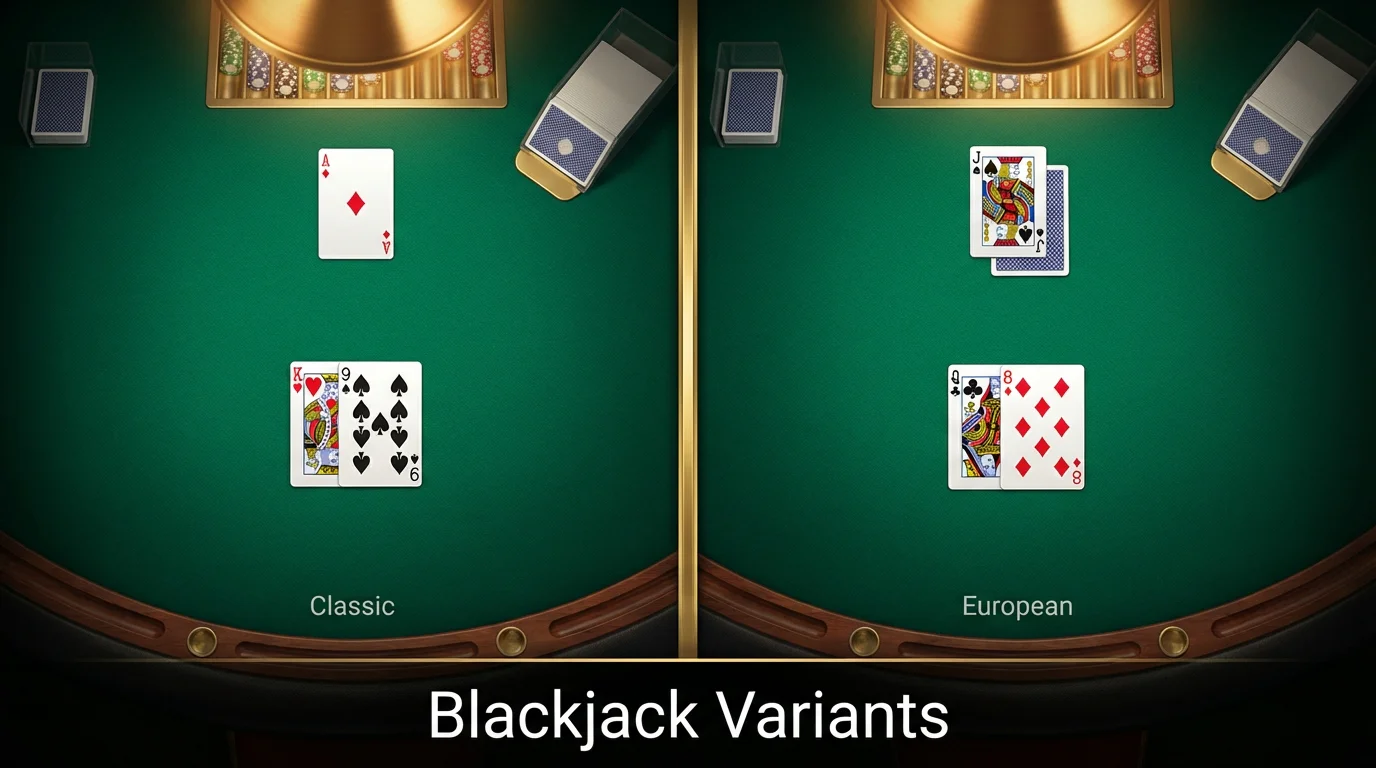
Classic Blackjack is the most common version in UK online casinos. It typically uses six or eight decks, dealer stands on all 17s (including soft 17), doubling is allowed on any two cards, double after split is permitted, and blackjack pays 3:2. Under these rules with perfect basic strategy, the house edge is approximately 0.43% to 0.5%. This is the baseline against which other variants should be measured.
European Blackjack uses two decks rather than six or eight, which is theoretically favourable — fewer decks reduce the house edge. However, European Blackjack typically restricts doubling to hard totals of 9, 10, and 11 only, and the dealer does not receive a hole card. Instead, the dealer draws their second card after all players have acted. This “no hole card” rule means you can lose your double and split bets to a dealer blackjack, which adds roughly 0.11% to the house edge. Net result: approximately 0.42% house edge with optimal play. Competitive with classic, but the doubling restrictions make certain hands less profitable.
Atlantic City Blackjack uses eight decks, dealer stands on soft 17, and allows late surrender — the option to forfeit half your bet after seeing your first two cards and the dealer’s upcard. Late surrender is valuable on specific hard totals (15 and 16) against strong dealer cards, reducing the expected loss on those hands. Double after split is permitted, and the dealer peeks for blackjack (protecting your split and double bets). House edge: approximately 0.35% with optimal play including correct surrender decisions. This is one of the most player-friendly rule sets you will find.
Vegas Strip Blackjack uses four decks, dealer stands on soft 17, and permits doubling on any two cards plus double after split. No surrender. The dealer peeks for blackjack. Four-deck play is slightly more favourable than six or eight decks, and the full doubling flexibility helps. House edge: approximately 0.35% with perfect play. Comparable to Atlantic City but without the surrender option.
Spanish 21 removes all four 10-value cards from each deck — the tens are gone, but jacks, queens, and kings remain. That removal significantly hurts the player, since 10-value cards are the most valuable cards in blackjack. To compensate, Spanish 21 offers a suite of bonus payouts: a 21 made from five or more cards pays extra, a 6-7-8 or 7-7-7 in mixed suits pays a bonus, and late surrender is available. The dealer hits soft 17 in most versions. Despite the bonus payouts, the removal of tens pushes the house edge to approximately 0.40% with a specialised strategy — but that strategy differs significantly from standard basic strategy, and players who use standard charts will face a considerably higher edge.
Blackjack Switch deals two hands simultaneously and allows the player to swap the second card between hands. This is a powerful advantage — you can construct better starting hands from mediocre deals. To offset it, dealer 22 pushes against all player totals except blackjack, and blackjack pays even money (1:1) instead of 3:2. House edge with optimal strategy is approximately 0.58%, but errors are more costly because the switching decisions add a layer of complexity most players underestimate.
| Variant | Decks | Dealer Soft 17 | Key Feature | House Edge |
|---|---|---|---|---|
| Atlantic City | 8 | Stands | Late surrender | ~0.35% |
| Vegas Strip | 4 | Stands | Full double flexibility | ~0.35% |
| Spanish 21 | 6-8 | Hits | No 10s, bonus payouts | ~0.40% |
| European | 2 | Stands | No hole card | ~0.42% |
| Classic (UK) | 6-8 | Stands | Standard rules | ~0.43-0.50% |
| Blackjack Switch | 6-8 | Hits | Card swap, BJ pays 1:1 | ~0.58% |
How Individual Rules Change the House Edge
Dealer stands on soft 17 versus hits — that single rule shifts the edge by approximately 0.2%. When the dealer hits soft 17, they have an additional chance to improve a hand that would otherwise stop at 17. This benefits the house, because the probability of improving (drawing an ace through 4) outweighs the probability of busting. If you are comparing two otherwise identical games and one says “dealer hits soft 17,” that game costs you an extra 0.2% of every pound wagered over the long run.
Number of decks affects the house edge because fewer decks increase the probability of being dealt a natural blackjack (which pays 3:2, a player advantage) and improve the effectiveness of doubling and splitting. The shift from eight decks to one deck, all other rules being equal, reduces the house edge by roughly 0.5%. In practice, single-deck games in UK casinos often come with restrictive rules — reduced blackjack payouts or limited doubling — that offset or exceed this deck advantage. Always check the full rule set, not just the deck count.
Blackjack payout is the single highest-impact rule. A standard 3:2 payout on natural blackjack is a cornerstone of the game’s low house edge. Some tables — particularly those labelled “6:5 blackjack” — pay only 6:5, which adds approximately 1.4% to the house edge. That alone turns a player-friendly game into one of the worst bets on the casino floor. Avoid 6:5 blackjack under all circumstances.
Double after split allows you to double down on hands created by splitting. This is worth approximately 0.14% to the player. Its absence costs you fractional value on specific pair splits, particularly splitting twos, threes, fours, and sixes against weak dealer cards where the resulting hand would benefit from doubling.
Late surrender lets you forfeit half your bet instead of playing a hand with poor odds. Against a dealer 10 or ace, surrendering hard 15 and hard 16 is the optimal play and saves roughly 0.07% overall. It does not appear in most UK online blackjack games, making Atlantic City variants that include it marginally more valuable.
Resplit aces allows you to split again if you receive another ace after splitting a pair of aces. Most games restrict split aces to a single card each and do not allow resplitting. When resplitting is permitted, it saves approximately 0.06%. A small figure, but indicative of how granular rule differences accumulate.
How to Pick the Best Blackjack Variant in a UK Casino
Check the rules table before you sit down. Every online blackjack game in a UKGC-licensed casino is required to display its rules, typically accessible through the game’s help or information screen. The key items to verify: blackjack payout (must be 3:2), whether the dealer stands or hits on soft 17, whether doubling after split is allowed, the number of decks, and whether surrender is available. If the game pays 6:5 on blackjack, close the table and find another one.
When multiple games offer comparable rules, prefer the one with fewer decks, dealer stands on soft 17, and double after split permitted. These three factors, in descending order of impact, represent the most accessible edge reductions available through game selection alone.
The Variant You Choose Is Your First Strategic Decision
Game selection is the decision you make before the cards are dealt — and it sets the ceiling on how well basic strategy can perform. A player executing flawless basic strategy at a 6:5 table with the dealer hitting soft 17 is still at a worse disadvantage than a mediocre player at a 3:2 table with favourable rules. The first player is optimising within a bad system. The second is benefiting from a good one.
The differences between variants are measured in tenths of a percentage point, which sounds trivial until you calculate what those tenths cost over hundreds of sessions. A player betting £10 per hand across 10,000 hands per year faces a total handle of £100,000. At 0.35% house edge, the expected loss is £350. At 0.58%, it is £580. The difference — £230 per year — is the cost of not checking the rules before playing. That is real money, spent on nothing.
Every blackjack session begins with a choice of table. Make it the first strategic decision, not an afterthought. The cards are random. The rules are not.