

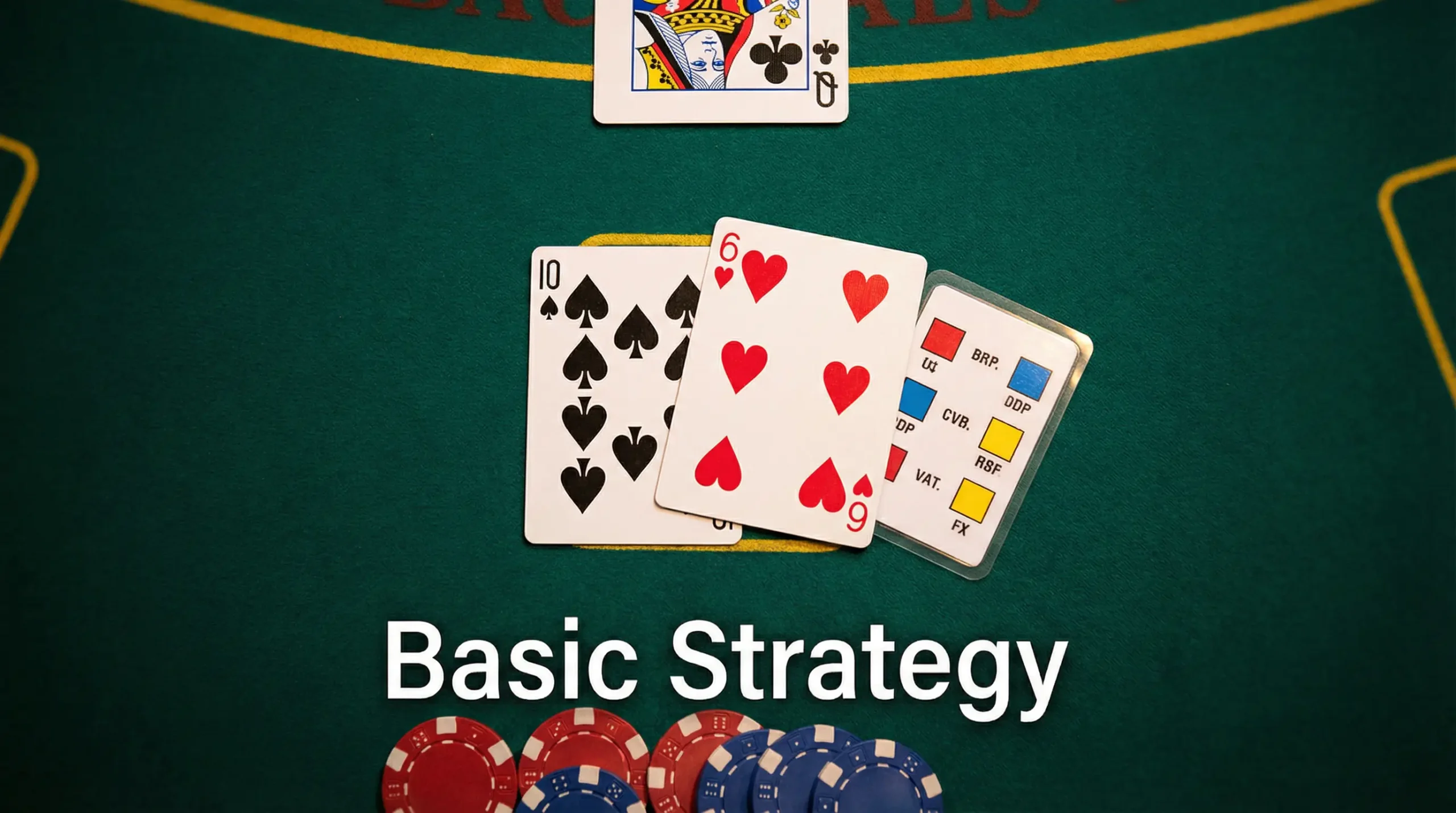
Basic Strategy Is Not Optional — It Is Optimal
Every hand of blackjack has one correct decision — basic strategy tells you what it is. Not a good decision, not a reasonable decision, but the mathematically optimal one given your cards and the dealer’s upcard. The chart exists because mathematicians in the 1950s and 1960s ran every possible hand combination through probability calculations and determined, for each scenario, which action produces the lowest expected loss or the highest expected gain. The work has been refined since, but the fundamentals have not changed. The maths is settled.
Playing without basic strategy is not a style choice. It is volunteering to give the casino a larger edge than it already holds. The house edge on a standard UK blackjack game played with perfect basic strategy sits around 0.4% to 0.6%, depending on the specific rule set. The same game played on gut instinct typically delivers a house edge of 2% to 5%. That difference — between knowing the chart and guessing — is the difference between one of the best odds in any casino and one of the worst.
The chart is not secret, not complicated, and not difficult to learn. It is, however, counterintuitive in places. That is where most players abandon it, and where most of the value is lost.
The Complete Basic Strategy Chart for UK Blackjack
Hard totals, soft totals, pairs — every decision mapped. The chart below applies to the most common UK online blackjack rule set: dealer stands on soft 17, double after split allowed, no surrender, blackjack pays 3:2, and six or eight decks. If the specific game you play uses different rules, certain cells may shift — but this chart covers the vast majority of tables you will encounter.
Hard Totals
A hard total is any hand without an ace counted as 11. These decisions cover the largest share of hands you will play.
| Your Hand | 2 | 3 | 4 | 5 | 6 | 7 | 8 | 9 | 10 | A |
|---|---|---|---|---|---|---|---|---|---|---|
| 17-20 | S | S | S | S | S | S | S | S | S | S |
| 16 | S | S | S | S | S | H | H | H | H | H |
| 15 | S | S | S | S | S | H | H | H | H | H |
| 14 | S | S | S | S | S | H | H | H | H | H |
| 13 | S | S | S | S | S | H | H | H | H | H |
| 12 | H | H | S | S | S | H | H | H | H | H |
| 11 | D | D | D | D | D | D | D | D | D | D |
| 10 | D | D | D | D | D | D | D | D | H | H |
| 9 | H | D | D | D | D | H | H | H | H | H |
| 5-8 | H | H | H | H | H | H | H | H | H | H |
H = Hit, S = Stand, D = Double (hit if doubling is not allowed).
Soft Totals
A soft total includes an ace counted as 11. These hands are more flexible because the ace can revert to 1 if you draw a high card, which makes doubling down more attractive in several spots.
| Your Hand | 2 | 3 | 4 | 5 | 6 | 7 | 8 | 9 | 10 | A |
|---|---|---|---|---|---|---|---|---|---|---|
| A,9 (20) | S | S | S | S | S | S | S | S | S | S |
| A,8 (19) | S | S | S | S | S | S | S | S | S | S |
| A,7 (18) | D | D | D | D | D | S | S | H | H | H |
| A,6 (17) | H | D | D | D | D | H | H | H | H | H |
| A,5 (16) | H | H | D | D | D | H | H | H | H | H |
| A,4 (15) | H | H | D | D | D | H | H | H | H | H |
| A,3 (14) | H | H | H | D | D | H | H | H | H | H |
| A,2 (13) | H | H | H | D | D | H | H | H | H | H |
Pairs
When dealt two cards of equal value, you have the option to split. Whether you should depends on your pair and the dealer’s upcard. Splitting is not always correct — in several cases, playing the hand as a hard total is the better mathematical choice.
| Your Hand | 2 | 3 | 4 | 5 | 6 | 7 | 8 | 9 | 10 | A |
|---|---|---|---|---|---|---|---|---|---|---|
| A,A | P | P | P | P | P | P | P | P | P | P |
| 10,10 | S | S | S | S | S | S | S | S | S | S |
| 9,9 | P | P | P | P | P | S | P | P | S | S |
| 8,8 | P | P | P | P | P | P | P | P | P | P |
| 7,7 | P | P | P | P | P | P | H | H | H | H |
| 6,6 | P | P | P | P | P | H | H | H | H | H |
| 5,5 | D | D | D | D | D | D | D | D | H | H |
| 4,4 | H | H | H | P | P | H | H | H | H | H |
| 3,3 | P | P | P | P | P | P | H | H | H | H |
| 2,2 | P | P | P | P | P | P | H | H | H | H |
P = Split, H = Hit, S = Stand, D = Double (hit if doubling is not allowed).
Why You Hit 16 Against a Dealer 10 — The Logic Behind the Chart
The chart is not arbitrary — every cell is based on probability calculations that compare the expected value of each possible action. The decisions that feel wrong are usually the ones where the maths is doing the most work.
Take the hand that frustrates more players than any other: hard 16 versus a dealer 10. Every instinct says stand. You have 16. If you hit and draw anything above a 5, you bust. The bust probability is roughly 62%. Standing feels safer. But standing is not safer — it is just a different kind of losing. When the dealer shows a 10, their probability of making a hand of 17 or better is approximately 77%. If you stand on 16, you lose whenever the dealer finishes with 17 through 21, which happens the vast majority of the time. Your expected loss from standing is roughly -0.54 units per hand. Your expected loss from hitting is roughly -0.51 units. Hitting loses less.
That distinction — losing less rather than winning — is what basic strategy is really about. Most blackjack hands are losing propositions for the player. The chart does not turn them into winners. It selects the action that loses the smallest amount over thousands of repetitions. The improvement is marginal on any single hand but substantial over a playing career.
The same logic applies to doubling soft 18 against a dealer 5 or 6. You already have a strong hand. Why risk it? Because the dealer is in a weak position (a 5 or 6 upcard gives the dealer the highest bust probability), and your soft total means you cannot bust by taking one more card. The expected value of doubling in that spot exceeds the expected value of standing. You are not “risking” a good hand — you are increasing your stake at a moment when the odds tilt in your favour.
Splitting eights against a dealer 10 or ace is another hand that provokes resistance. You are breaking up 16 — a terrible hand — into two hands that each start with 8. Against a strong dealer card, both new hands are underdogs. But two underdogs starting from 8 lose less combined than one hand stuck on 16. The split does not create good hands. It replaces one very bad hand with two less bad ones, and the total expected loss shrinks.
Understanding this logic does not require you to memorise expected value tables. It requires accepting one principle: basic strategy minimises expected loss per hand, not per moment of emotional comfort. The two are often in conflict. The chart resolves that conflict in favour of the maths every time.
How to Memorise and Apply Basic Strategy
Start with hard totals — they cover the majority of hands. If you learn nothing else, the hard total section of the chart will address roughly 65% of all hands dealt. Soft totals and pairs together cover the remaining 35%, but hard totals are both the most common and the simplest to learn.
The hard total rules reduce to a handful of principles. Always stand on 17 or higher. Always hit on 8 or lower. Double on 11 against everything except an ace. Double on 10 against everything except a 10 or ace. Stand on 12 through 16 when the dealer shows 2 through 6 (the dealer’s bust zone), and hit when the dealer shows 7 through ace. The exceptions — hitting 12 against a dealer 2 or 3, for instance — are worth learning next, but the broad strokes cover most situations.
Soft totals follow a pattern once you see it: the lower your soft total, the more aggressively you should play (hitting and doubling), because the ace protects you from busting. As the soft total rises, you transition toward standing. The doubling opportunities cluster around soft 13 through soft 18 against dealer 4 through 6.
Pairs are the smallest set. Always split aces and eights. Never split tens or fives. Split twos, threes, sixes, and sevens against dealer 2 through 6 or 7. Nines split against most cards except 7, 10, and ace. Those rules alone cover the majority of pair decisions.
Practice in free-play mode before playing for real money. Most UK online casinos offer demo versions of their blackjack games. Use them. Deal yourself hands, consult the chart, and make the correct play until the decisions feel automatic. The goal is not to eliminate thinking — it is to make the correct action the default one, so that deviations require conscious effort rather than the other way around.
Perfect Play, Imperfect Outcomes
Basic strategy minimises the house edge — it does not eliminate it. A player executing every decision flawlessly will still lose over time, because the house edge, however small, is always positive. The casino has structural advantages that no strategy can overcome: the dealer acts last, and the player busts first. Basic strategy reduces the cost of these disadvantages to their mathematical minimum, but it does not erase them.
The value of basic strategy is not in transforming blackjack into a winning game. It is in making blackjack the closest thing to a fair game that a casino offers. At 0.5% house edge, a basic strategy player wagering £10 per hand over 200 hands expects to lose £10 in the long run. A player guessing at the same table might lose £40 to £100 over the same number of hands. The difference is not theoretical. It is the price of every instinct-driven stand on 15 against a dealer 10, every refusal to split eights, every failure to double when the numbers say you should.
Learn the chart. Use the chart. Accept that even perfect play produces losing sessions — and know that those sessions cost less than they would have without it. That is all basic strategy promises. It is also all it needs to promise.
Visit casinogamesrealmoneyuk for full UK real money casino game guides and reviews.
Find out if you owe anything in our Gambling Tax UK guide.