

Do UK Players Pay Tax on Casino Winnings?
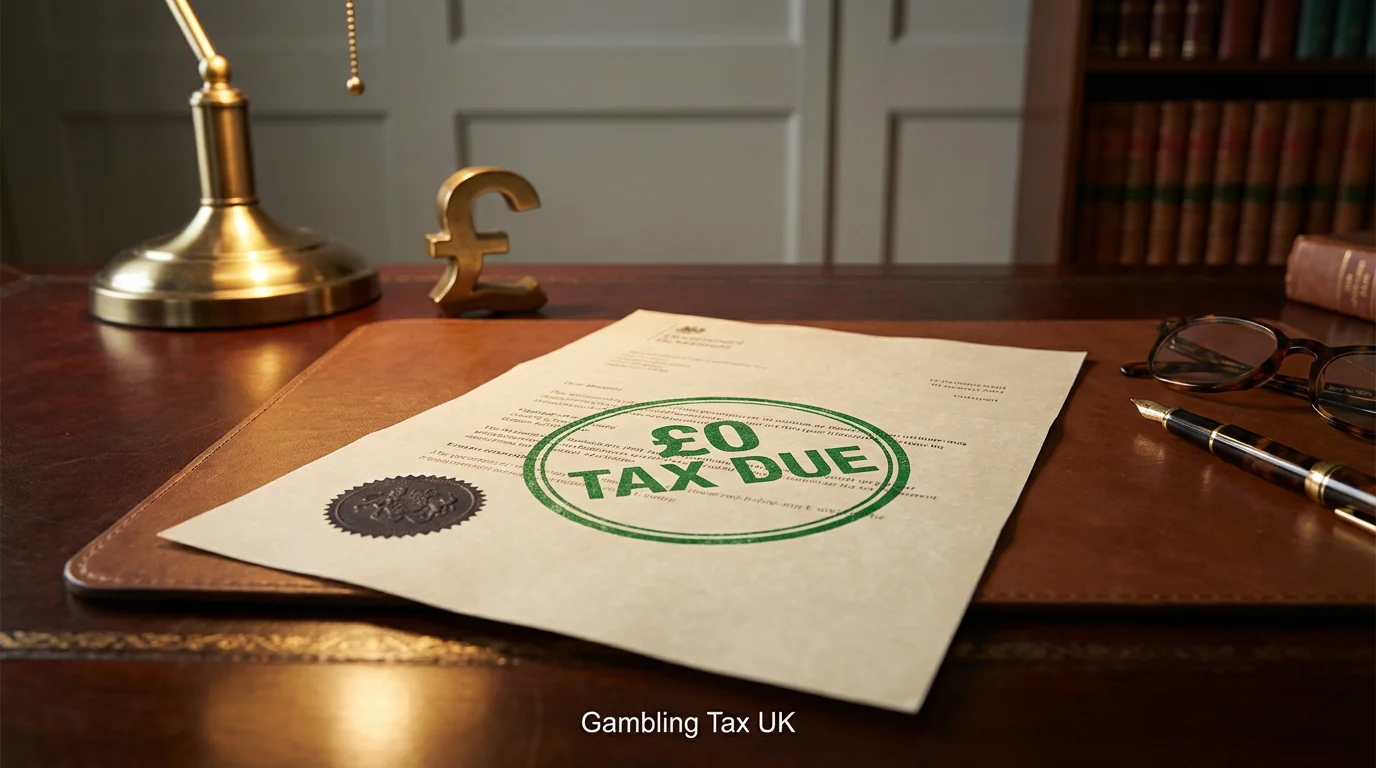
No. UK gambling winnings are not taxable — but it is worth understanding why. The short answer is unambiguous: under current UK law, winnings from gambling — whether from casino games, sports betting, poker, bingo, the lottery, or any other form of licensed gambling — are not subject to income tax, capital gains tax, or any other tax. You keep everything you win. No deductions, no reporting obligations, no threshold above which tax applies.
This tax-free status is not an oversight or a loophole. It is a deliberate policy choice rooted in how HMRC classifies gambling income. Understanding the rationale helps clarify the few edge cases where the rules become less straightforward, and it provides useful context for UK players who may be accustomed to hearing about gambling taxes in other countries — particularly the United States, where the treatment is very different.
HMRC Rules on Gambling Income
Gambling winnings are not income for tax purposes under UK law. The principle is long-established and has been upheld through multiple court decisions and HMRC guidance. The reasoning is straightforward: gambling is classified as a recreational activity involving chance, not a trade or profession. Winnings from chance-based activities are treated as windfall gains rather than earned income, and windfall gains from gambling are specifically excluded from taxation.
The tax burden in UK gambling falls entirely on the operators, not the players. Since the Point of Consumption tax was introduced in December 2014, all operators offering gambling services to UK customers — regardless of where they are based — must pay a 21% tax on their gross gambling revenue (the difference between the total stakes received and the winnings paid out). This operator-level tax replaced the previous system where duty was applied at the point of supply, and it ensures that offshore operators serving UK players pay the same tax rate as domestic ones.
For players, this means the economics are clean. Your winnings are gross and net simultaneously — there is no difference between what the casino pays you and what you take home. A £5,000 jackpot win is £5,000 in your pocket. A £50 cashout from a Tuesday evening session is £50. The tax has already been paid by the operator through the Point of Consumption levy. You are not evading it. It simply does not apply to you.
This treatment extends to all forms of gambling winnings. Casino games (slots, table games, live dealer), sports betting (singles and accumulators), poker (cash games and tournaments), bingo, the National Lottery, scratchcards, and spread betting on sports — all produce tax-free winnings for UK-resident players. There is no form of licensed gambling in the UK where the player owes tax on the result.
Losses are equally non-deductible. Because gambling winnings are not taxable income, gambling losses cannot be offset against other income for tax purposes. You cannot claim gambling losses as a tax deduction. This symmetry is important: the tax system treats gambling as entirely outside the income framework. What you win is not taxed. What you lose is not deductible. The two are logically consistent.
Edge Cases — Professional Gamblers, Overseas Winnings, Gifts
If gambling becomes your trade, HMRC may reclassify it. The tax-free status of gambling winnings rests on the classification of gambling as a recreational activity. In rare cases, that classification can be challenged — though the bar is high and the circumstances are narrow.
Professional gambling is the most discussed edge case. If HMRC determines that an individual is gambling as a trade — with the systematic, organised, and profit-driven characteristics of a business — the winnings could theoretically be classified as trading income and taxed accordingly. In practice, this reclassification is exceptionally rare. UK courts have consistently held that gambling, even when conducted with skill and regularity, does not constitute a trade because the element of chance prevents it from meeting the legal definition of a trading activity. The leading case, Graham v Green (1925), established that gambling profits are not taxable, and subsequent rulings have reinforced this position. A professional poker player who plays full-time and derives their primary income from poker remains tax-free under current precedent.
That said, the boundary is not absolute. If a gambling activity crosses into territory where the element of chance is minimal — for example, if an individual operates a matched-betting business with guaranteed mathematical profits derived from exploiting bonus structures — HMRC might argue that the activity resembles a trade. No definitive ruling has been issued on this specific scenario, and individual circumstances vary. Players who derive significant, systematic income from gambling-adjacent activities (arbitrage, bonus exploitation at scale) may wish to seek professional tax advice.
Overseas winnings are generally treated the same as domestic winnings for UK tax residents. If you win at a casino in Las Vegas, those winnings are not taxable in the UK. However, the US may withhold tax at source (typically 30% on certain gambling winnings for non-US citizens), and you would need to file a claim with the IRS to recover the withholding under the US-UK tax treaty. The UK does not add further tax on top. Similar withholding rules apply in several other countries — always check local tax obligations when gambling abroad.
Gifts from winnings are covered by standard inheritance and gift tax rules. If you win £100,000 at a casino and give £50,000 to a family member, the gift may be subject to inheritance tax rules if you die within seven years. The original win is not taxed, but the gift enters the standard IHT framework. This is not a gambling-specific rule — it applies to any large gift regardless of the source of funds.
How UK Tax Rules Compare to Other Countries
The US taxes gambling winnings above $600 — the UK taxes nothing. That contrast is the starkest in the global landscape, but it is not the only one. Tax treatment of gambling winnings varies significantly by jurisdiction, and UK players enjoy one of the most favourable regimes in the world.
In the United States, all gambling winnings are considered taxable income. Casinos issue a W-2G form for wins above specified thresholds ($600 for most games, $1,200 for slot jackpots), and the player must report winnings on their federal tax return. State taxes may apply on top. Losses can be deducted, but only up to the amount of winnings reported.
In Australia, recreational gambling winnings are tax-free — similar to the UK. Professional gamblers may be taxed, but the definition is narrow. In Canada, casual gambling winnings are not taxed, though professional gambling income is. Most European countries exempt gambling winnings from personal taxation, taxing operators instead — the same model the UK uses.
The UK’s approach — taxing the operator through the Point of Consumption levy and exempting the player entirely — is widely regarded as one of the cleanest systems in operation. It generates substantial government revenue (the gambling industry paid approximately £3 billion in taxes in recent fiscal years) while keeping the player’s financial relationship with gambling straightforward: what you win is what you keep.
Tax-Free Does Not Mean Risk-Free
The tax benefit is real — but it is not a reason to gamble. Knowing that your winnings are not taxed is useful financial information. It simplifies your relationship with gambling income and removes a concern that players in other countries must manage. But the tax-free status does not change the fundamental economics of casino play: the house edge ensures that the expected outcome of any extended gambling activity is a net loss. You do not pay tax on your winnings, but in expectation, there will be no net winnings to tax.
The tax-free status is best understood as a feature of the UK regulatory environment that makes gambling marginally more straightforward for the player, not as an incentive to gamble or a factor in deciding how much to wager. Your session budget, your bankroll management, and your awareness of the house edge matter infinitely more than the tax rate on hypothetical winnings. The tax rule is simple. The gambling is not. Keep the two separate.
Visit casinogamesrealmoneyuk for full UK real money casino game guides and reviews.
Discover Immersive and Lightning variants in our Live Roulette UK guide.