

The House Always Wins — Here Is Exactly How
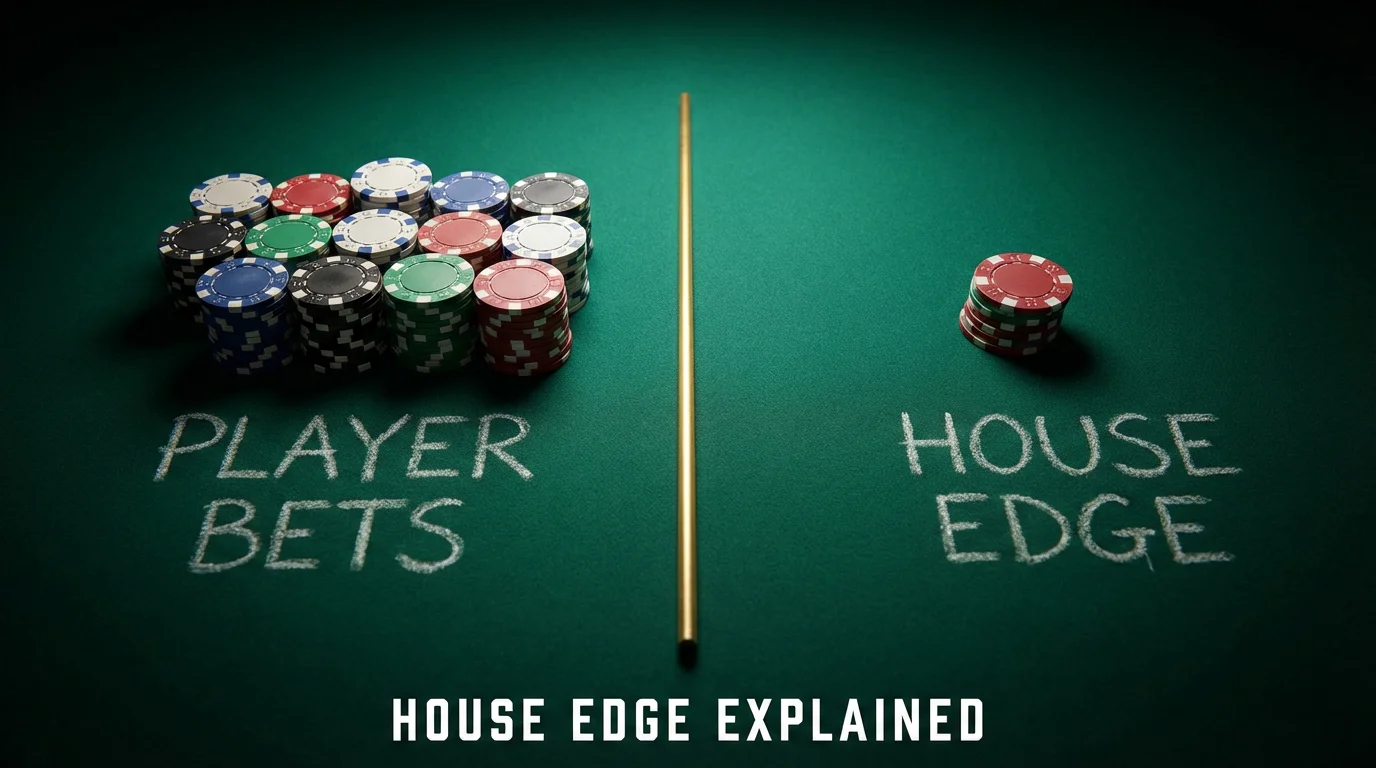
The house edge is the mathematical mechanism behind every casino’s profit. It is not a hidden fee, a rigged algorithm, or a conspiracy. It is a structural property of every casino game, built into the rules and payout tables, that ensures the casino retains a small percentage of every pound wagered over time. The edge is publicly disclosed — or at least calculable from publicly available information — and it operates identically whether you are on a winning streak or a losing one.
Every casino game has a house edge. Blackjack has one. Roulette has one. Slots have one. The edges vary dramatically — from under 0.5% to above 15% — and understanding where your preferred games fall on that spectrum is the single most useful piece of knowledge any casino player can possess. It does not tell you whether you will win or lose in any given session. It tells you how much the game costs to play, per pound, over the long run. That cost is the price of admission, and knowing it lets you choose which games deserve your money and which do not.
How the House Edge Is Calculated
Expected value per bet equals probability of winning multiplied by the payout, minus probability of losing multiplied by the loss. That formula — expressed differently in different contexts but always reducible to the same components — is the mathematical core of every house edge calculation.
Start with the simplest example: a coin flip game where the casino pays you £1.90 for every £1 bet when you win, and you lose £1 when you lose. The probability of winning is 50%. The probability of losing is 50%. Expected value = (0.50 × £0.90) – (0.50 × £1.00) = £0.45 – £0.50 = -£0.05. You expect to lose 5 pence per £1 bet. The house edge is 5%.
Now apply the same logic to European roulette. A straight-up bet on a single number pays 35:1 (you receive £35 profit plus your £1 stake). The probability of winning is 1/37 (one pocket out of 37). The probability of losing is 36/37. Expected value = (1/37 × £35) – (36/37 × £1) = £0.9459 – £0.9730 = -£0.0270. You expect to lose approximately 2.7 pence per £1 bet. The house edge is 2.70%.
The calculation works for any bet on the roulette table because the payout structure is consistent: every bet is priced as if there were 36 pockets on the wheel, but there are 37 (or 38 on American wheels). The difference between the true odds and the payout odds is the house edge. On European roulette, that difference is exactly one pocket — the zero — which gives the house 1/37 = 2.70%.
For games with more complex structures — slots, for instance — the house edge is expressed as RTP (return to player), which is the inverse. A slot with 96% RTP has a 4% house edge. The calculation is the same in principle: across all possible outcomes, weighted by their probabilities, the game returns 96 pence of every £1 wagered and retains 4 pence. The specific probabilities and payouts are determined by the game’s maths model and verified by independent testing laboratories.
The house edge is always expressed as a percentage of the total amount wagered, not the initial deposit. This distinction matters. If you deposit £100 and play 500 spins at £1 per spin, you have wagered £500. A 4% house edge applies to £500, not £100, producing an expected loss of £20. The number of times you recycle your balance through bets — the “churn” — determines the total amount wagered and therefore the total expected cost.
House Edge Across Major Casino Game Categories
Blackjack 0.5%, baccarat 1.06%, roulette 2.7%, slots 2% to 8%. Those figures define the competitive landscape of casino mathematics. Here is how the major categories compare, and what drives the variation within each one.
Blackjack offers the lowest house edge of any widely available casino game — approximately 0.4% to 0.6% with perfect basic strategy, depending on the specific rule set. The edge is low because the player makes meaningful decisions (hit, stand, double, split) that influence the outcome. Imperfect strategy raises the effective house edge significantly — a player using intuition rather than the chart faces a house edge of 2% to 5%.
Video poker rivals blackjack at the top of the RTP spectrum. Full-pay Jacks or Better returns 99.54% (house edge 0.46%) with optimal strategy. Some variants, like Deuces Wild and Double Bonus Poker, exceed 100% RTP — a theoretical player edge — though achieving that return requires flawless play and access to full-pay tables, which are increasingly rare.
Baccarat carries a house edge of 1.06% on the banker bet and 1.24% on the player bet — both excellent by casino standards. The game requires no skill; the edge is entirely structural. The tie bet, at 14.36% house edge, is one of the worst bets in the casino.
European roulette carries a fixed 2.70% house edge on all bets. French roulette with La Partage reduces the edge on even-money bets to 1.35%. American roulette doubles it to 5.26%. The game is pure chance — no strategy can alter the edge.
Slots are the most variable category. RTP ranges from approximately 92% to 99%, with most UK online slots falling between 94% and 97%. The house edge on a 96% RTP slot is 4% — significantly higher than blackjack or baccarat, but comparable to or better than many live casino game show titles. Slot RTP is fixed by the game developer and verified by testing laboratories. The player has no strategic influence on the return.
Live casino game shows carry house edges that vary by bet type, typically ranging from 3.4% (number bets on Dream Catcher) to 9% or more (bonus segment bets on Monopoly Live). The average across a mixed betting strategy is approximately 4% to 6%, making game shows among the more expensive casino formats per pound wagered.
| Game | House Edge | Strategy Impact |
|---|---|---|
| Blackjack (basic strategy) | 0.4–0.6% | High — correct decisions reduce edge |
| Video Poker (optimal play) | 0.2–0.8% | High — hold decisions determine return |
| Baccarat (banker) | 1.06% | None — fixed rules |
| French Roulette (La Partage) | 1.35% | None — game selection only |
| European Roulette | 2.70% | None |
| Slots | 2–8% | None — game selection only |
| Game Shows | 3.4–9%+ | Bet selection varies edge |
| American Roulette | 5.26% | None |
Common Misconceptions About the House Edge
The house edge does not mean you lose that percentage every session. This is the most common misunderstanding, and it leads players to either overestimate their losses (concluding that a 4% edge means they will definitely lose 4% of their deposit) or underestimate them (concluding that 4% is too small to matter).
The house edge is a long-run average. Over thousands of bets, your actual losses will converge toward the expected value. Over a single session, your results will vary wildly from the average. You might win 50% of your deposit in one session and lose everything in the next. The house edge predicts neither outcome — it predicts the average across all sessions, which is the number the casino uses to run its business.
Another misconception: a lower house edge means you will lose less money. This is true only if your total wagering is equal. A player who bets £10 per spin on a 4% slot for 200 spins wagers £2,000 and expects to lose £80. A player who bets £1 per hand on 0.5% blackjack for 200 hands wagers £200 and expects to lose £1. The blackjack player’s lower expected loss comes not just from the lower edge but from the lower total wagering. If both players wagered £2,000, the slot player would still expect to lose more — but the gap would be £80 versus £10, not £80 versus £1.
The house edge is also not a measure of how “rigged” a game is. A 4% edge does not mean the game cheats 4% of the time. It means the payout structure is calibrated to return, on average, 96 pence for every £1 wagered. The outcomes are random and independently generated. The edge is structural, not behavioural.
Understanding the Edge Is the First Step — Not the Last
Knowing the maths does not prevent losses — it prevents delusions. The house edge does not change because you understand it. The casino does not pay you less or more based on your awareness of the numbers. What changes is your relationship with the game: you stop expecting to win in the long run, you start evaluating games by their cost rather than their promise, and you make informed decisions about where to allocate your gambling budget.
The house edge is the price of entertainment. A 2.7% edge on roulette means every £100 wagered costs £2.70 in expectation. Whether that cost is acceptable depends on how much entertainment you derive from the experience — the same way a cinema ticket costs money without guaranteeing you will enjoy the film. The difference is that a casino lets you set the ticket price by choosing the game, the bet size, and the number of rounds. Knowing the edge gives you the information to set that price consciously rather than discovering it after the session ends.
Visit casinogamesrealmoneyuk for full UK real money casino game guides and reviews.
Learn optimal strategy in our Video Poker Online UK guide.