

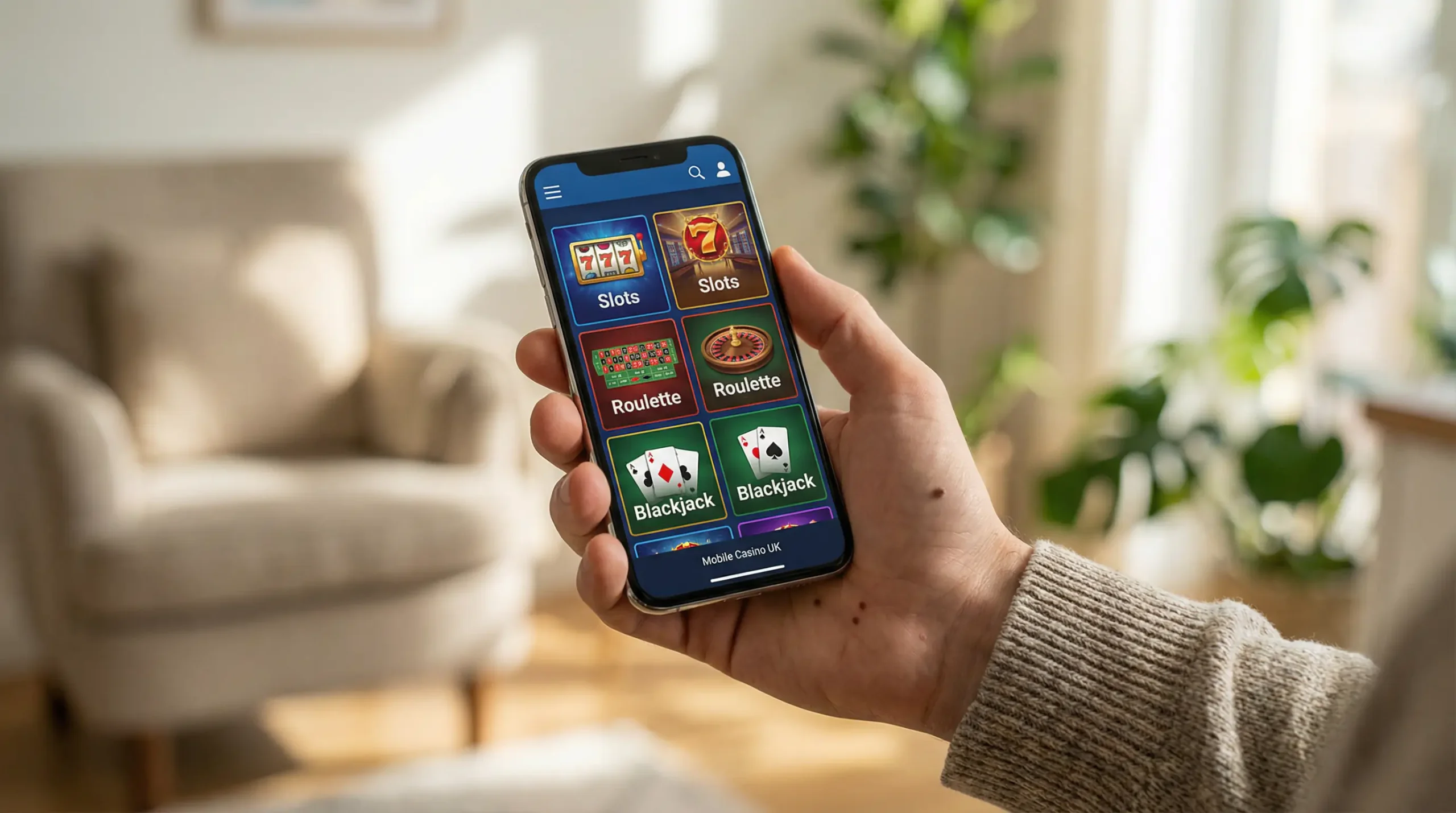
Mobile Casino — The Default Way UK Players Access Games
Mobile overtook desktop for casino play years ago. The shift was not gradual — it was decisive, and by 2026 the majority of UK online casino sessions originate from smartphones. The industry followed the audience: every major UK casino now builds its platform mobile-first, designing interfaces for touchscreens before adapting them to desktop monitors. If you play online casino games in the UK, you almost certainly do so on your phone at least some of the time.
The mobile experience is not a reduced version of the desktop product. Modern mobile casinos offer the same account management, the same banking options, and nearly the same game selection as their desktop counterparts. The differences that remain — and there are some — relate to how that content is delivered (native app versus browser), how it performs on variable hardware and connections, and which specific games are available on smaller screens.
Understanding those differences helps you choose between app and browser access, manage your data and battery consumption, and avoid the small number of games that genuinely do not translate to mobile play.
Native Apps vs Browser Play — What Is the Difference
Apps offer push notifications; browsers offer full game libraries. That trade-off captures the core distinction, though the practical differences extend further.
Native apps are downloadable applications from the Apple App Store or Google Play Store. They install on your device, occupy storage space (typically 50 to 150 MB), and run within their own application framework. The advantages are speed and integration: apps load faster than browser-based casinos because core assets are stored locally, they can send push notifications about promotions and account activity, and they integrate with device features like biometric login (Face ID, fingerprint). The App Store and Play Store also impose their own quality and security standards on listed apps, which provides an additional layer of vetting beyond UKGC licensing.
The disadvantages are equally concrete. Apps take up storage space on your device. They require periodic updates, which must be downloaded and installed. Game selection within an app may be slightly reduced compared to the browser version, because some game providers do not package their titles for native app distribution. And the approval process for app store listing means that new features or games may appear on the browser version first.
Browser-based play (also called instant play or web app) runs directly in your mobile browser — Safari, Chrome, or Firefox — without requiring a download. You navigate to the casino’s website, log in, and play. The advantages are immediacy and completeness: no download, no storage cost, no update delays, and access to the full game library as it exists on the server. Browser-based casinos use HTML5, which renders game interfaces natively in the browser with no plugins required.
The disadvantages are performance-related. Browser play depends on your internet connection for every asset load, which means slower initial game launches on weaker connections. There are no push notifications (though some casinos use browser notifications with permission). And biometric login is available only if the browser supports it, which varies by device and browser version.
For most UK players, the choice between app and browser comes down to habit. If you play at one casino regularly and value the convenience of a home screen icon with fast launch and biometric access, the app is the better choice. If you play at multiple casinos or prefer not to commit device storage, browser play is more flexible. The game experience itself — once a game is loaded and running — is effectively identical in both formats.
One practical note: some UK casinos do not offer native apps at all, operating exclusively through browser-based mobile sites. This is not a quality indicator — several highly regarded casinos run browser-only operations. If a casino you are evaluating does not have an app, check the browser experience before dismissing it.
Performance, Load Times, and Data Usage
Live dealer games consume 300 to 500 MB per hour. That figure is the most important data point for any player who uses mobile data rather than Wi-Fi for casino sessions. Standard slot play is far lighter — typically 10 to 50 MB per hour, depending on the game’s graphical complexity and animation density. RNG table games sit in a similar range. But live dealer games stream continuous HD video, and that stream is the dominant data cost.
Load times vary by game type and connection quality. Slots with complex animations and multi-layered bonus rounds may take 5 to 15 seconds to load on a 4G connection, and 2 to 5 seconds on 5G or Wi-Fi. Simpler games load in under 3 seconds. Live dealer lobbies load quickly, but the video stream takes a moment to stabilise — expect 3 to 8 seconds before the feed becomes smooth. On slower connections, live dealer video may buffer or drop to a lower resolution, which affects the visual experience but not the gameplay.
Battery consumption is a genuine concern for extended sessions. Live dealer games, with their continuous video stream and active data connection, drain battery faster than any other casino format — expect to lose roughly 15% to 25% per hour on a typical smartphone, depending on screen brightness and device age. Slots are less demanding, consuming approximately 8% to 15% per hour. If you plan a long session, keep a charger accessible or reduce screen brightness to extend battery life.
Device age matters. Casino games in 2026 are designed for hardware that is two to four years old at most. Devices older than five years may experience lag, overheating, or interface rendering issues — particularly on graphically intensive slots and live dealer streams. If your device struggles with mobile casino performance, the issue is almost certainly hardware rather than the casino’s software.
Game Selection and Mobile-Specific Limitations
Some titles are desktop-only — but the gap is shrinking. The vast majority of games released in the last five years are built mobile-first using HTML5, which means they run identically on desktop and mobile. The residual desktop-only titles tend to be older Flash-based games that were never converted, or niche titles from smaller providers who have not prioritised mobile optimisation.
In practical terms, a major UK casino’s mobile library covers 90% to 98% of its desktop library. The missing titles are almost exclusively older slots with outdated interfaces. If a specific game matters to you, check whether it is available on mobile before committing to a casino — most platforms allow you to browse the game library without logging in.
Mobile does impose one genuine limitation on game experience: screen real estate. Games designed for wide desktop monitors must be compressed to fit a portrait or landscape smartphone screen. Most modern slots handle this well, with responsive interfaces that rearrange elements for the smaller display. Live dealer games are more challenging — the betting interface, video feed, and chat must all share a limited screen, which can feel cramped on devices smaller than 6 inches. Landscape orientation typically provides a better live dealer experience, as it gives the video feed more horizontal space.
Table games like blackjack and roulette are well-suited to mobile. The interfaces are inherently simpler — a betting layout, a few action buttons, and a result display — and translate cleanly to touchscreen interaction. In many cases, the mobile versions of RNG table games are more intuitive than their desktop counterparts, because the touch interface maps naturally to chip placement and button taps.
Mobile-First Is Now Mobile-Only for Most Players
If a casino does not work perfectly on your phone, it does not work. That standard is not aspirational — it is the reality of how UK players evaluate and use online casinos in 2026. A desktop-only casino, or one with a poor mobile experience, is effectively invisible to the majority of its potential audience. The platforms that succeed are the ones that deliver a fast, complete, and visually coherent experience on a 6-inch screen.
For players, this means the mobile experience should be a primary evaluation criterion, not an afterthought. Test the casino on your phone before depositing. Load a few games. Check the banking interface. Navigate the account settings. If any of those tasks feel clunky, slow, or confusing, the casino has not invested in the platform that matters most — and there are plenty of alternatives that have.
Visit casinogamesrealmoneyuk for full UK real money casino game guides and reviews.
Look up any term in our Casino Glossary.