

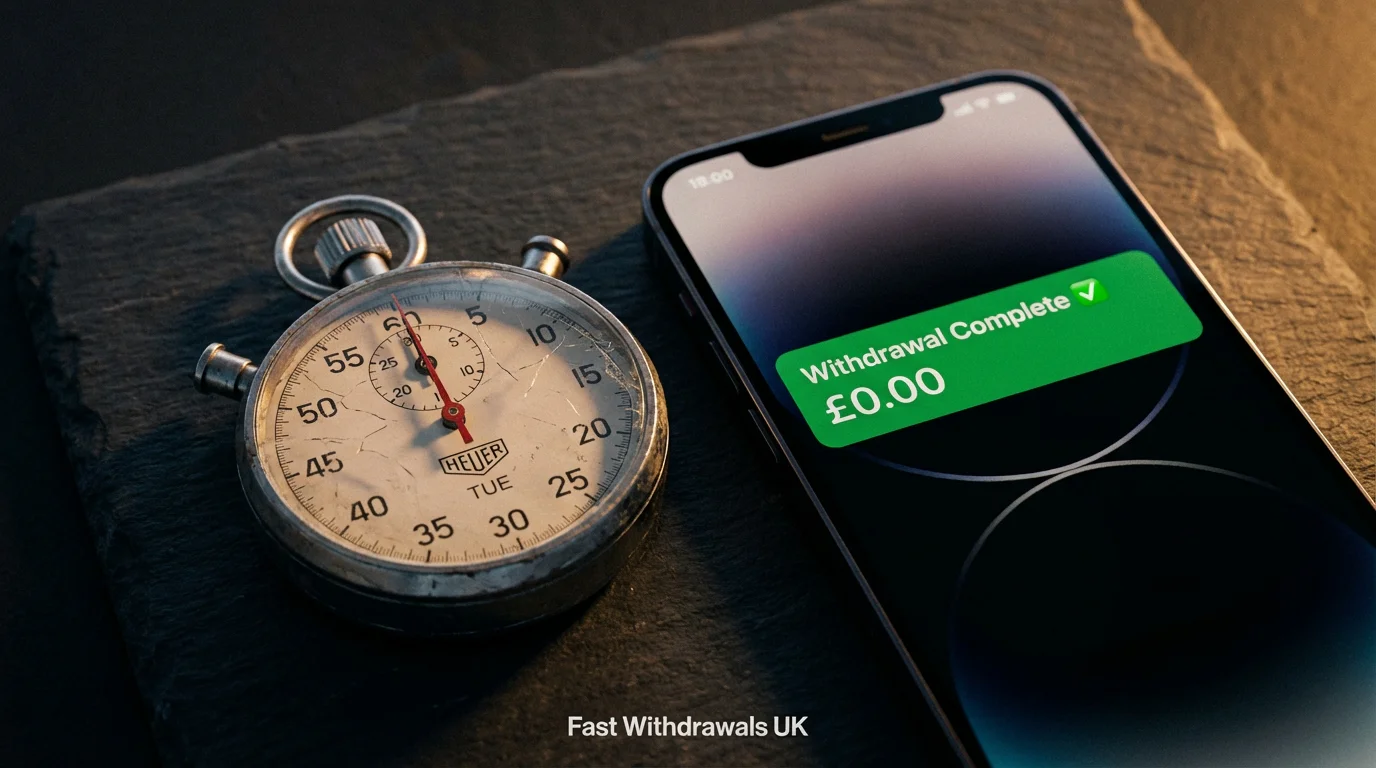
Same-Day Withdrawals — What Is Possible in the UK
Some UK casinos process withdrawals in under an hour — others take days. The gap is not marginal. A player at one UKGC-licensed casino can request a withdrawal at 10am and have the funds in their PayPal account by 11am. A player at another licensed casino, using the same payment method, might wait 48 to 72 hours for the same transaction. Both casinos are legal, both are regulated, and the difference is entirely a matter of how the operator chooses to handle outbound payments.
Withdrawal speed is a function of three factors: the payment method you use, the casino’s internal processing time (often called the “pending period”), and whether your KYC verification is complete. Two of those three factors are within your control. The third — the casino’s pending period — is a platform decision that varies dramatically across the market and is rarely advertised with the same enthusiasm as deposit speed.
This guide ranks the fastest withdrawal methods, identifies what causes delays, and provides practical steps to minimise the time between requesting a cashout and seeing the money in your account.
Fastest Withdrawal Methods Ranked
E-wallets lead, followed by debit cards, then bank transfers. This hierarchy holds across virtually every UKGC-licensed casino, though the absolute times vary by operator.
PayPal is the fastest mainstream withdrawal method in the UK casino market. Once the casino processes the withdrawal request, funds arrive in your PayPal account within minutes. The bottleneck is the casino’s processing time, not PayPal’s. At the fastest operators, the entire cycle — request to receipt — takes under one hour. At slower operators, PayPal withdrawals still typically arrive within 24 hours. From PayPal to your bank account takes an additional one to two working days, though you can spend directly from your PayPal balance immediately.
Skrill and Neteller perform similarly to PayPal in terms of withdrawal speed. Once processed by the casino, funds appear in your e-wallet account within minutes. The distinction from PayPal is that transferring from Skrill or Neteller to your bank account incurs a fee (typically 1% to 2%) and takes one to two working days. If you maintain a Skrill or Neteller balance for regular casino use, the withdrawal is effectively instant once the casino releases it.
Visa and Mastercard debit cards are slower by nature. After the casino processes the withdrawal, the funds must pass through the card network’s settlement system, which takes one to three working days. Some casinos advertise “Visa Fast Funds” or similar accelerated services that aim for same-day processing, but actual delivery depends on your card issuer. In practice, debit card withdrawals at the fastest casinos arrive within 24 hours. At average operators, two to three working days is typical.
Bank transfers are consistently the slowest. Processing times of three to five working days are standard, and some casinos take even longer. The method is reliable for large sums where e-wallet limits might be restrictive, but for routine withdrawals, it is the worst option available.
| Method | Best Case | Typical | Worst Case |
|---|---|---|---|
| PayPal | Under 1 hour | 0-24 hours | 48 hours |
| Skrill / Neteller | Under 1 hour | 0-24 hours | 48 hours |
| Debit Card | Same day | 1-3 working days | 5 working days |
| Bank Transfer | 1-2 working days | 3-5 working days | 7+ working days |
These figures assume completed KYC and no active bonus wagering. Either of those conditions, if unresolved, will add days to any withdrawal regardless of payment method.
What Causes Withdrawal Delays and How to Avoid Them
Pending periods, incomplete KYC, and bonus wagering are the three main blockers. Understanding each one lets you preemptively eliminate most delay sources before they affect a real withdrawal.
Pending periods are casino-imposed holds on withdrawal requests. After you submit a cashout, the request enters a “pending” state for a set duration — typically 0 to 72 hours — before the casino begins processing it. During this period, some casinos allow you to reverse the withdrawal and return the funds to your playing balance. Pending periods exist partly for operational reasons and partly because a percentage of players reverse withdrawals and continue playing, which benefits the casino. The best operators have zero pending periods, processing withdrawals immediately upon request. Others impose 24, 48, or even 72-hour holds. Check the casino’s withdrawal policy before depositing — if the pending period exceeds 24 hours, consider it a red flag for cashout friction.
Incomplete KYC verification is the most common cause of unexpected delays. If you have not submitted or completed identity verification before requesting your first withdrawal, the casino cannot legally release your funds. The verification process itself can take 24 to 72 hours, and any issues with documentation (blurry images, expired ID, address mismatch) restart the clock. The solution is simple: complete KYC immediately after registration, before you play a single hand or spin. Front-loading verification eliminates this delay entirely.
Active bonus wagering locks your withdrawal until the wagering requirement is met. If you accepted a bonus and the wagering is incomplete, your balance — including any winnings — is restricted. Some casinos allow you to forfeit the bonus and withdraw your remaining real-money balance; others lock the entire amount until wagering is cleared. If fast access to your money is a priority, consider declining bonuses altogether and playing with unrestricted cash.
Withdrawal limits can also create delays for larger cashouts. Many casinos impose daily, weekly, or monthly withdrawal caps — commonly £5,000 to £10,000 per day, or £20,000 to £50,000 per month. If your withdrawal exceeds the cap, the casino processes it in instalments, extending the total time to receive the full amount. High-volume players should verify withdrawal limits before committing to a platform.
How to Get Your Money Faster
Verify your identity early, use e-wallets, and do not accept bonuses if you want instant access. Those three actions, taken together, eliminate the vast majority of withdrawal delays at any UKGC-licensed casino.
Complete KYC on day one. Submit your photo ID, proof of address, and payment method verification before making your first deposit. This ensures that when a withdrawal request goes in, there is no documentation queue between you and your money.
Deposit with the same method you intend to withdraw to. Most casinos require that withdrawals go back to the deposit method — if you deposit via debit card, your withdrawal goes to the same card. If you want e-wallet speed on the way out, deposit with the same e-wallet.
Choose casinos with zero or short pending periods. This information is not always prominently displayed, but player forums and review sites frequently report actual withdrawal experiences. A casino that processes PayPal withdrawals in under an hour is a meaningfully different experience from one that holds them for 48 hours.
Your Winnings Are Not Real Until They Are in Your Bank
Withdrawal speed is a feature — treat it like one. When comparing casinos, players evaluate game selection, bonus terms, and customer support. Withdrawal speed deserves equal weight. A casino that takes five days to pay you is not offering the same product as one that pays in five hours, regardless of how similar the game lobbies look.
The moment you press “withdraw” is the moment the casino’s true priorities become visible. Fast payouts signal an operator that respects your right to access your funds. Slow payouts signal one that benefits from delay — either through reversed withdrawals, extended play, or simple operational indifference. The money sitting in your casino account is not yours until it leaves the platform. The speed at which it leaves is a measure of how seriously the operator takes that obligation.
Visit casinogamesrealmoneyuk for full UK real money casino game guides and reviews.
Explore interactive Casino Game Shows from live studios.