

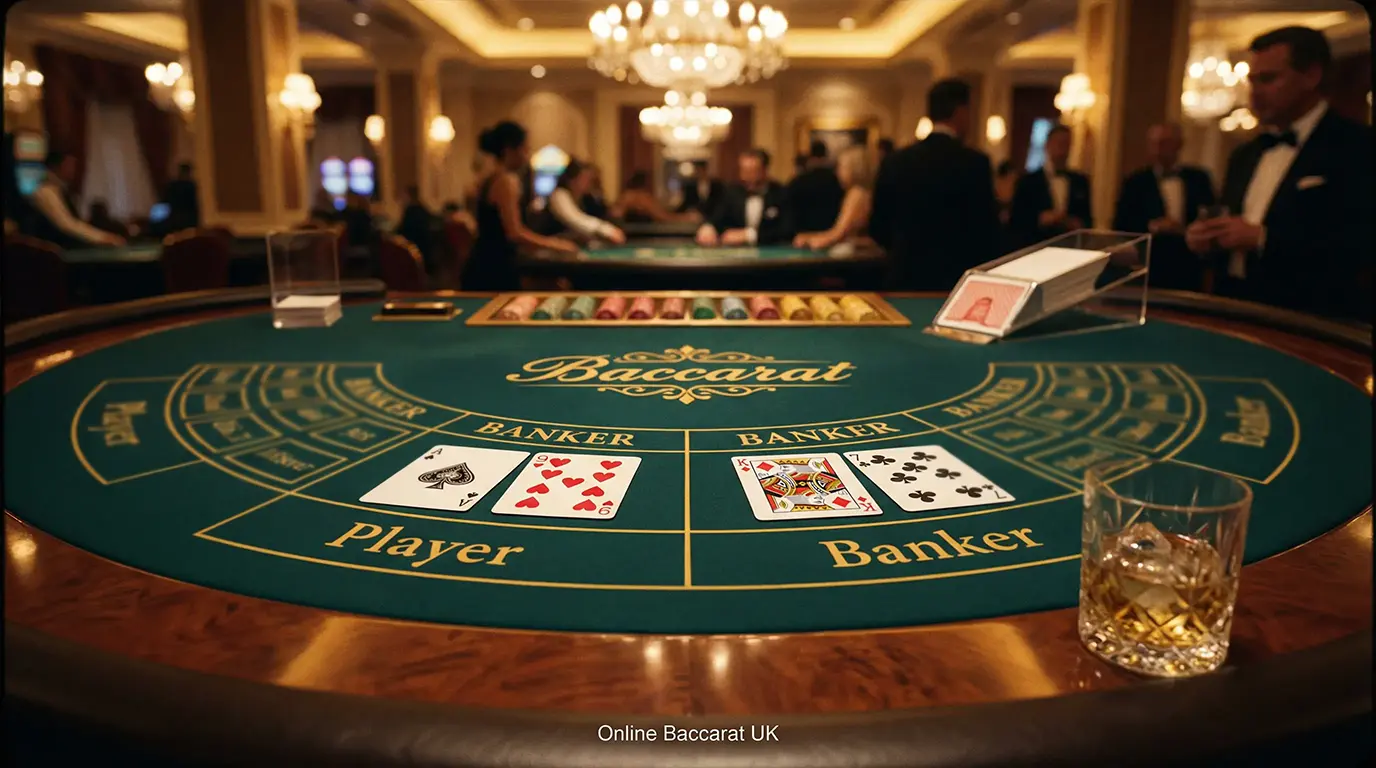
Baccarat — The Simplest High-Odds Game in the Casino
Three bets, fixed drawing rules, and a house edge under 1.1% on the banker. Baccarat is the most mechanically simple table game in any casino, and also one of the most mathematically favourable — a combination that should make it far more popular among UK online players than it actually is. The game requires no skill, no decision-making during play, and no strategy beyond choosing which of two meaningful bets to place. Everything else — the card drawing, the third-card rules, the hand resolution — happens automatically according to a fixed set of rules that neither the player nor the dealer can influence.
The game’s reputation does not help. Baccarat carries an image of high-roller exclusivity inherited from its prominence in James Bond films and Asian VIP rooms. That image has nothing to do with the online version, where minimum bets start as low as £1 and the game plays identically regardless of stake. What matters is the maths: the banker bet carries a 1.06% house edge, the player bet carries 1.24%, and the tie bet carries 14.36%. Those first two figures make baccarat one of the best odds available in any casino game, beaten only by optimal blackjack and certain video poker variants.
This guide covers how baccarat works, why the odds favour it, and what the limited strategic landscape actually looks like.
How Baccarat Works — Player, Banker, Tie
Cards are dealt by fixed rules — you do not make decisions, you make predictions. Before the cards are dealt, you bet on one of three outcomes: Player wins, Banker wins, or Tie. That is the only decision you make. Everything after that is automated.
Two cards are dealt to the Player position and two to the Banker position. Card values follow a specific system: aces count as 1, cards 2 through 9 count at face value, and 10s, jacks, queens, and kings count as 0. The hand total is the last digit of the sum. If the Player’s cards are a 7 and an 8, the total is 15, which counts as 5. If the Banker holds a king and a 4, the total is 4. The highest possible hand value is 9.
If either hand totals 8 or 9 on the initial deal, it is called a “natural” and the round ends immediately. No additional cards are drawn. The higher natural wins. If both are equal, it is a tie.
If neither hand has a natural, a fixed set of third-card rules determines whether one or both hands draw an additional card. The Player position draws a third card if its total is 0 through 5 and stands on 6 or 7. The Banker’s decision is more complex and depends on both the Banker’s own total and the value of the Player’s third card. These rules are not optional or variable — they are the same in every standard baccarat game worldwide, and they are executed automatically by the software or dealer.
The key point is that you have no influence on the outcome once your bet is placed. You cannot hit, stand, double, or split. You are betting on which of two automated hands will finish closer to 9. This pure-prediction structure is what makes baccarat simultaneously the simplest game in the casino and one of the most efficient for the player — the house edge comes only from the structural probability difference between the two positions, not from player errors or suboptimal decisions.
Payouts are straightforward: a winning Player bet pays 1:1 (even money). A winning Banker bet also pays 1:1, minus a 5% commission that the casino deducts from the winnings. A winning Tie bet pays 8:1 at most UK online casinos, though some tables offer 9:1. The commission on the Banker bet is the mechanism that gives the casino its edge on what would otherwise be a near-even proposition — and it is the reason the Banker bet, despite the commission, remains the mathematically superior choice.
Baccarat Odds and the Banker Bet Advantage
The banker bet carries a 1.06% house edge — after the 5% commission. That figure is sometimes misquoted or misunderstood, so it is worth unpacking. In a standard eight-deck baccarat game, the Banker hand wins approximately 45.86% of resolved hands (excluding ties), the Player hand wins approximately 44.62%, and ties occur approximately 9.52% of the time.
The Banker wins more often than the Player because of the third-card rules. The Banker position acts second and its drawing rules are conditional on the Player’s third card, which gives it a slight informational advantage — not in the sense that anyone makes a decision, but in the sense that the fixed rules are structured to give the Banker a marginally better probability of winning. This asymmetry is inherent to the game’s design and is the reason the 5% commission exists: without it, always betting Banker would give the player a positive expected value.
With the commission, the expected value of a £100 Banker bet is -£1.06. The expected value of a £100 Player bet is -£1.24. The difference is small but consistent. Over 1,000 bets of £10 each, a Banker bettor expects to lose £106, while a Player bettor expects to lose £124. Over a year of regular play, the difference accumulates.
The Tie bet exists in a different mathematical universe. At 8:1 payout, the house edge on a Tie bet is approximately 14.36%. At 9:1 (available at some tables), it drops to approximately 4.84% — a substantial improvement but still worse than both the Banker and Player bets. The tie occurs roughly once in every 10.5 hands. The 8:1 payout does not come close to compensating for the frequency, which is why every credible baccarat guide in existence advises against it.
Some players track outcomes on scorecards — “roads” in baccarat terminology — looking for streaks or patterns. This is the most common ritual in baccarat and also the most mathematically pointless. Each hand is dealt from a shoe with hundreds of remaining cards, and the outcome of one hand has a negligible effect on the probabilities of the next. Pattern tracking in baccarat is the gambler’s fallacy in formal dress.
Baccarat Variants Available at UK Online Casinos
Speed Baccarat, Squeeze Baccarat, Lightning Baccarat — different formats, same rules. The core game of baccarat is mechanically identical across all major variants. What varies is the presentation, pacing, and — in the case of Lightning Baccarat — the payout structure.
Standard Live Baccarat (Evolution, Pragmatic Play) is the baseline: a dealer, eight-deck shoe, and a round length of approximately 45 to 60 seconds including betting time. The squeeze ritual — where the dealer slowly peels back the cards to reveal their value — is a staple of the standard format and adds a layer of suspense that many players consider essential to the baccarat experience.
Speed Baccarat removes the squeeze and compresses rounds to approximately 27 seconds. Cards are dealt face-up immediately. The game is functionally identical to standard baccarat with no rule changes, but the faster pace means more hands per hour — roughly 80 to 100 compared to 40 to 50 at a standard table. As with Speed Roulette, higher pace at the same stake means higher hourly cost.
Lightning Baccarat (Evolution) applies the Lightning mechanic familiar from Lightning Roulette. Before each round, one to five random card values are assigned multipliers of 2x, 3x, 4x, 5x, or 8x. If a winning hand contains a lightning card, the payout is multiplied. If the winning hand contains two lightning cards, the multipliers compound. The maximum potential multiplier is 512x (8x times 8x on a five-card hand with multiple lightning hits, though this is astronomically rare). A 20% fee is added to all bets to fund the multiplier pool, which increases the effective cost per hand. The house edge is approximately 1.5% to 2.0% — higher than standard baccarat’s 1.06% on banker, but the multiplier potential adds variance.
No Commission Baccarat eliminates the 5% commission on Banker wins. Instead, a Banker win with a total of 6 pays 0.5:1 (half the bet) rather than 1:1. This rule compensates the casino for the removed commission and results in a house edge of approximately 1.46% on the Banker bet — worse than standard baccarat’s 1.06%. The format appeals to players who dislike the commission deduction, but the maths is clearly inferior.
Bet Banker, Skip Tie — Baccarat’s One Useful Strategy
The tie bet’s 14.36% house edge makes it the worst bet on the table — and one of the worst in the casino. That is the single most important strategic statement in baccarat, and it constitutes roughly 90% of what any player needs to know about optimal play. Bet on Banker. Do not bet on Tie. If the 5% commission bothers you, bet on Player at a marginally higher house edge. But never, under any circumstances, treat the Tie bet as a viable option.
Baccarat’s strategic simplicity is its greatest strength. There are no complex charts to memorise, no decisions to agonise over, no deviations based on shoe composition. You bet, you watch, and the game resolves itself. The house edge on the Banker bet is among the lowest in any casino game, and achieving it requires nothing more than placing the same bet every hand. No other game offers this combination of low edge and zero complexity.
The irony is that baccarat’s simplicity may be what keeps it underplayed by UK recreational players. There is no illusion of control, no sense that skill is being applied, no narrative of the clever player outsmarting the house. There is only a bet and a result. For players who can accept that honesty — who prefer clean odds over the comforting fiction of influence — baccarat is among the most rational choices in any casino lobby.
Visit casinogamesrealmoneyuk for full UK real money casino game guides and reviews.
Understand how the UK Gambling Commission protects players.