

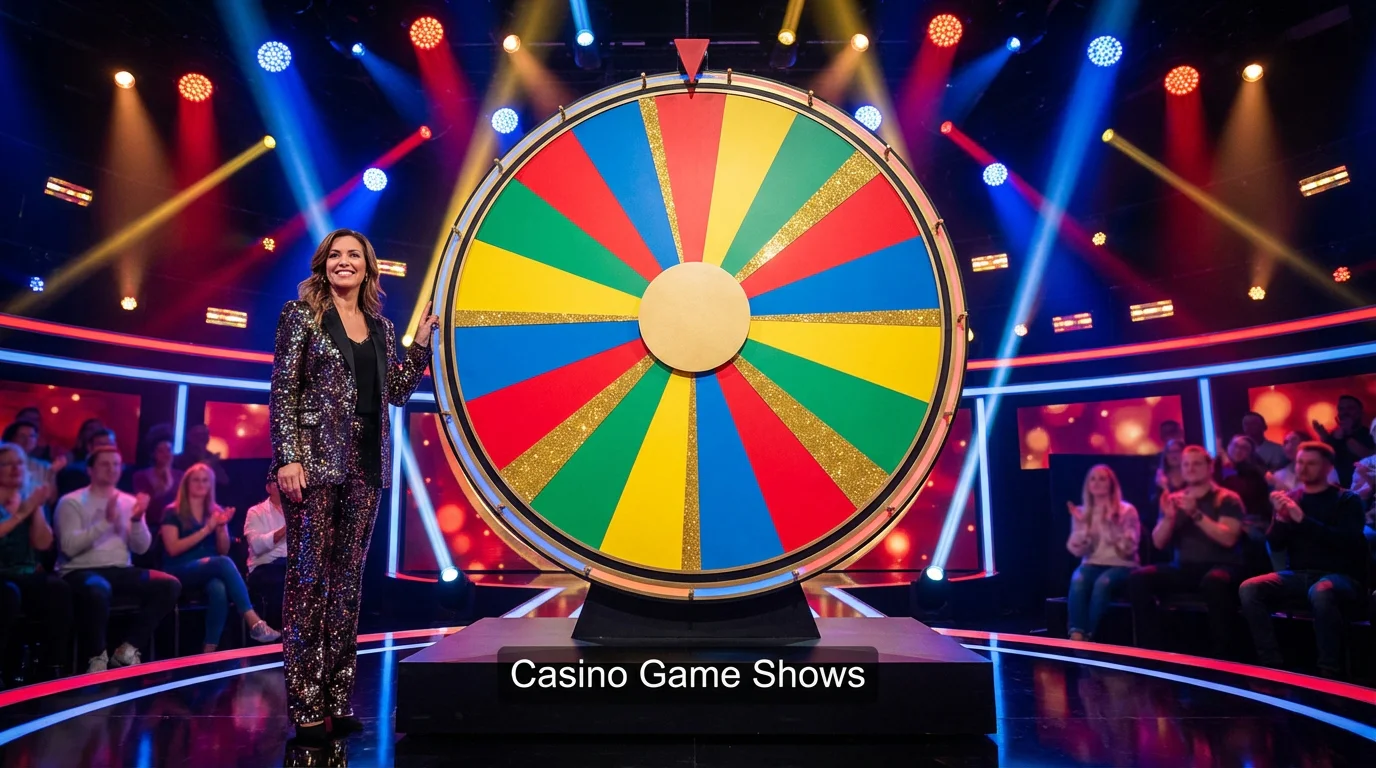
Casino Game Shows — Entertainment Disguised as Gambling
A wheel, a host, a crowd — game shows turned casino gaming into something watchable. Before Evolution launched Dream Catcher in 2017, the live casino floor was a place of focused, quiet play: blackjack dealers and roulette croupiers running tables with professional efficiency and minimal personality. Game shows changed that. They introduced presenters who chat, cheer, and react. They built oversized props — giant wheels, mechanical bonus boards, augmented-reality overlays. They created a format where spectating is almost as engaging as playing.
The result is the fastest-growing segment of the live casino market. Game shows now account for a significant share of live casino revenue at major UK operators, and the category continues to expand with new titles launched each year. The appeal crosses demographic lines that traditional casino games do not: game shows attract younger players, casual players, and people who would never sit at a blackjack table but will happily bet on a spinning wheel hosted by someone with the energy of a television presenter.
That accessibility comes at a mathematical cost. Game show RTP is generally lower than table games, the house edge is higher, and the mechanics are designed to maximise entertainment time per pound — which is another way of saying they are designed to keep you betting. Understanding what game shows actually offer, in both entertainment and expected value, is the first step toward deciding whether they deserve your money.
Major Game Show Titles — Crazy Time, Monopoly Live, Deal or No Deal
Each show has different mechanics, different RTP, and different appeal. The UK market currently features a half-dozen major game show titles, all produced by Evolution (which also operates under the Playtech brand for some titles). Here are the ones that dominate lobby space and player attention.
Crazy Time is the flagship. A massive money wheel with 54 segments offers four bonus games: Coin Flip, Cash Hunt, Pachinko, and Crazy Time itself. The main wheel lands on number bets (1, 2, 5, 10) or triggers one of the bonus rounds, each of which features its own mechanic and multiplier potential. Crazy Time’s headline attraction is the Crazy Time bonus round, where a giant virtual wheel can deliver multipliers exceeding 20,000x. The base-game RTP varies by bet: the number segments average around 95.5%, while the bonus bet segments average 94% to 95%. Overall, the game sits in the 95% to 96% RTP range depending on your betting pattern. Variance is extremely high on the bonus bets.
Monopoly Live combines a money wheel with an augmented-reality Monopoly board game. The main wheel has number segments and two special positions: “2 Rolls” and “4 Rolls.” Landing on either triggers a 3D Monopoly board where Mr. Monopoly moves around the board collecting prizes. Chance and Community Chest cards add multipliers. The RTP is approximately 96.2% on the number bets and lower on the roll bets — around 91% to 93% for the “4 Rolls” position, which is one of the worst returns in the game show category. The Monopoly bonus is visually impressive and entertaining, but the maths is not kind.
Dream Catcher is the original casino game show — a simple money wheel with segments paying 1x, 2x, 5x, 10x, 20x, and 40x. Two multiplier segments (2x and 7x) occasionally boost the next spin’s payout. The simplicity is the draw: no bonus rounds, no complex mechanics, just a wheel and a bet. RTP is approximately 96.6% overall, which is the highest in the game show category. Dream Catcher functions as an entry point — a game show for people who have never tried one.
Deal or No Deal Live adapts the television format into a three-phase game: qualifying round (a spinning wheel), bank offer negotiation, and the final box opening. The game’s structure gives the illusion of decision-making — you can accept or reject the bank offer — but the expected value of accepting versus continuing is always transparent if you understand the maths. RTP is approximately 95.4%. The entertainment derives from the tension of the offer decision, even though the statistically correct choice is usually straightforward.
Funky Time (Evolution) is a newer entry designed as a successor to Crazy Time, with a 64-segment wheel, four bonus games (Bar, Stayin’ Alive, Disco, and VIP Disco), and a 1970s funk theme. The multiplier potential is extreme, with the VIP Disco round theoretically capable of delivering five-figure multipliers. RTP is comparable to Crazy Time — approximately 95% to 96% depending on bet allocation. The variance on bonus bets is even higher than Crazy Time’s, making it a game of long waits punctuated by occasional dramatic payouts.
The RTP Behind the Entertainment
Game shows typically run 92% to 96% RTP — lower than most table games. That range is wide, and the position within it depends heavily on which bets you place within each game. Number bets on the main wheel tend to carry higher RTP (95% to 96.6%). Bonus segment bets, which are the exciting ones — the ones that trigger the augmented-reality boards and multiplier rounds — tend to carry lower RTP (91% to 95%).
This creates a structural tension. The bets with the best expected value are the boring ones: wagering on “1” or “2” on a money wheel, which pays out frequently at low multiples. The bets that make game shows entertaining — the bonus triggers that unlock Pachinko boards and Monopoly rounds — are the most expensive per pound wagered. A player who exclusively bets on bonus segments in Monopoly Live is playing a game with an effective house edge of 7% to 9%. That is worse than American roulette.
The comparison to traditional table games is instructive. Basic strategy blackjack runs at 0.4% to 0.5% house edge. European roulette sits at 2.7%. Baccarat’s banker bet costs 1.06%. Even standard slots — the most criticised category in the casino — average 95% to 96% RTP, which is comparable to or better than most game show bets. Game shows occupy the uncomfortable position of offering some of the best entertainment value and some of the worst mathematical value simultaneously.
None of this means game shows are a bad choice for every player. It means the entertainment premium is real and quantifiable. You are paying more per hour for a more engaging experience. Whether that trade-off makes sense is personal. What matters is that you make it knowingly.
Why Game Shows Are the Fastest-Growing Live Casino Category
They attract players who would never sit at a blackjack table. That audience expansion is the core reason game shows have become the most commercially successful innovation in live casino gaming since the category’s inception. Traditional table games require knowledge — blackjack demands strategy, roulette has a complex betting layout, baccarat carries an air of exclusivity that intimidates newcomers. Game shows require nothing. Pick a segment. Watch the wheel. The learning curve is measured in seconds.
The production quality plays a significant role. Game show studios are designed to look like television sets, not casino floors. The presenters are hired for charisma and energy, not just card-dealing proficiency. The lighting, sound design, and visual effects are tuned to create moments of shared excitement — when the wheel slows toward a bonus segment and the presenter’s energy escalates, the chat erupts, and the multiplier screen fills the frame, the experience genuinely resembles watching a live TV show where you happen to have money on the outcome.
The social element is another differentiator. Game show chat rooms are more active than any other live casino format. Players congratulate each other on wins, commiserate on near-misses, and interact with the presenter in real time. For players who value the social dimension of gambling — the shared experience, the communal reaction — game shows deliver something that solo RNG play and even standard live tables cannot match.
From the operator’s perspective, game shows are commercially attractive because they generate high engagement at a favourable margin. Players tend to place more bets per session, play longer, and — crucially — bet on the high-margin bonus segments more frequently than the low-margin number bets. The entertainment quality sustains attention, and sustained attention translates to sustained wagering. It is a well-designed product by any commercial metric.
The Show Is Real — The Odds Are Not in Your Favour
Entertainment value is high, but the house edge is higher than it looks. Game shows are not a scam. They are well-produced, genuinely entertaining products that deliver exactly what they promise: a fun, engaging experience with real money on the line. The hosts are good at their jobs. The bonus rounds are exciting. The multiplier potential creates genuine anticipation. None of that is fake.
What is carefully obscured is the cost. The combination of moderate-to-low RTP and high engagement means game shows extract money from players more efficiently than most other casino formats — not because the house edge is uniquely high on a per-bet basis, but because the entertainment quality keeps players betting for longer and on higher-margin segments. A game that costs 5% per bet and holds your attention for two hours extracts more than a game that costs 2.7% per bet but bores you into quitting after thirty minutes.
If you enjoy game shows, play them. Budget for the cost, bet on number segments when you want to stretch your bankroll, and treat bonus bets as what they are: high-priced lottery tickets attached to spectacular production design. The show is worth watching. Just know what the admission costs.
Visit casinogamesrealmoneyuk for full UK real money casino game guides and reviews.
Meet the studios behind your games in our Casino Game Providers guide.