

One Extra Pocket, Double the Disadvantage
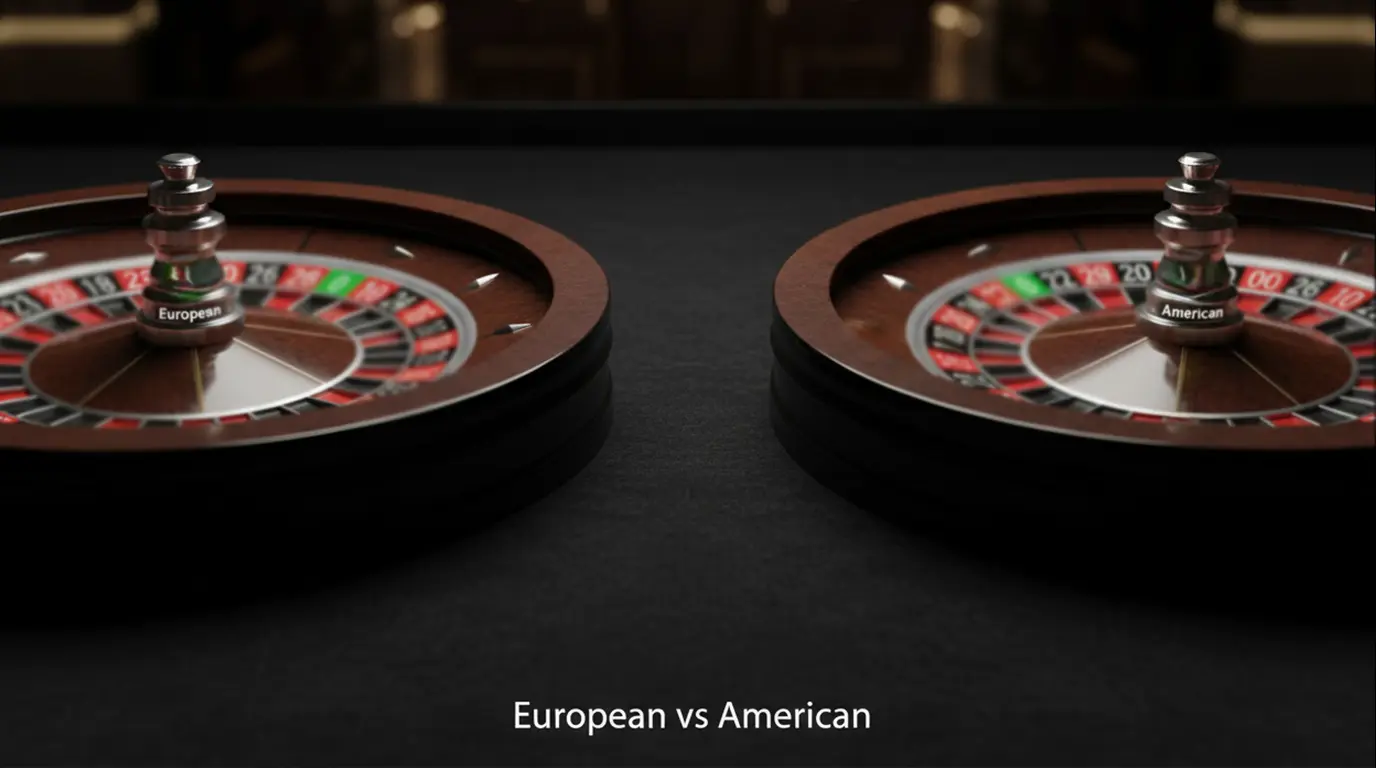
The difference between European and American roulette is one green zero — and it costs you. European roulette has 37 pockets: numbers 1 through 36 plus a single zero. American roulette has 38: the same 36 numbers plus a single zero and a double zero. That additional pocket does not add excitement. It does not create new betting options worth having. It simply increases the house edge from 2.70% to 5.26%, nearly doubling the rate at which the casino extracts money from every bet you place.
The two wheels look almost identical. The layouts are similar. The betting options carry the same names. But the mathematical relationship between player and house is fundamentally different, and the difference is always in the casino’s favour. Choosing between European and American roulette is not a matter of preference. It is a matter of arithmetic. One version costs you almost twice as much per spin as the other. There is no scenario in which the more expensive version is the better choice.
Side-by-Side — European vs American Roulette Rules and Odds
37 pockets versus 38 pockets: the maths diverges from there. Every difference between the two variants traces back to that single additional zero pocket on the American wheel, but the downstream effects touch every bet on the table.
| Feature | European | American |
|---|---|---|
| Pockets on wheel | 37 (0-36) | 38 (0, 00, 1-36) |
| Zero pockets | 1 (single zero) | 2 (zero and double zero) |
| House edge | 2.70% | 5.26% |
| Straight-up payout | 35:1 | 35:1 |
| True odds (straight-up) | 36:1 | 37:1 |
| Even-money bets | Red/Black, Odd/Even, High/Low | Same |
| Even-money win probability | 48.65% | 47.37% |
The payout structure is identical on both wheels. A straight-up bet on a single number pays 35:1 regardless of which version you play. But the probability of winning that bet is not the same. On a European wheel, a straight-up bet wins 1 time in 37 (2.70% probability). On an American wheel, it wins 1 time in 38 (2.63%). The payout does not adjust to reflect the lower probability — you still get 35:1. The gap between the true odds and the payout is where the house edge lives, and on the American wheel, that gap is wider.
The effect is more pronounced on even-money bets because the volume of these bets tends to be higher. A bet on red has an 18/37 chance on a European wheel (48.65%) and an 18/38 chance on an American wheel (47.37%). Over 1,000 bets of £10 each, the expected loss on European roulette is £270. On American roulette, it is £526. That is an additional £256 lost for the privilege of playing on a wheel with one extra pocket.
The American wheel also includes a unique bet not available on European tables: the “top line” or “basket” bet covering 0, 00, 1, 2, and 3. This five-number bet pays 6:1 and carries a house edge of 7.89% — the single worst bet on any standard roulette table. It exists because of the double zero and has no equivalent on the European layout. No strategy guide recommends it. Its existence is a useful illustration of how the additional zero degrades every aspect of the game’s mathematics.
The House Edge Calculation for Each Variant
European: 1/37 = 2.70%. American: 2/38 = 5.26%. The calculation is simple enough that it should be printed on the table.
On a European wheel, the house edge derives from the single zero pocket. There are 37 pockets but the payout is based on 36 (35:1 plus your original bet). The one pocket not covered by any number bet — the zero — is the casino’s mathematical margin. Every bet on the table has the same house edge of 2.70% because every bet pays as if the zero did not exist, but the zero does exist and the ball lands there 1 out of every 37 spins on average.
On an American wheel, the same logic applies but with two uncovered pockets: 0 and 00. The payout structure still assumes 36 numbers. The house holds the edge on both zero pockets, which gives it 2 out of 38 outcomes — hence 2/38 = 5.26%. The doubling is not coincidental. Two zero pockets produce almost exactly double the house edge of one zero pocket. (It is not precisely double because the denominator also changes from 37 to 38, but the effect is nearly identical.)
The expected loss per unit wagered tells the story most clearly. For every £100 you bet on European roulette, you expect to lose £2.70 over time. For every £100 on American roulette, you expect to lose £5.26. The difference — £2.56 per £100 — compounds over a session, a month, a year. A regular player betting £10 per spin at 30 spins per hour for 100 hours of annual play puts £30,000 through the table. On European roulette, the expected annual loss is £810. On American roulette, it is £1,578. The difference is nearly £770 per year, paid for nothing more than a second green slot on the wheel.
French Roulette — The Even Better Option
La Partage and En Prison reduce the even-money bet edge to 1.35%. French roulette uses the same 37-pocket wheel as European roulette — the layout and numbering are identical. What distinguishes it are two special rules that apply when the ball lands on zero, and both work exclusively on even-money bets (red/black, odd/even, high/low).
La Partage means “the sharing.” When zero hits, all even-money bets lose half their stake and the other half is returned to the player. Instead of losing the full bet to zero (as on a standard European wheel), you lose only 50%. This cuts the effective house edge on even-money bets in half: from 2.70% to 1.35%.
En Prison means “in prison.” When zero hits, even-money bets are not immediately lost. Instead, the bet is held “in prison” for the next spin. If the next spin produces a result that matches the original bet (e.g., you bet on red and the next spin lands red), your bet is returned without profit. If it does not match, the bet is lost. The mathematical effect is identical to La Partage — the house edge on even-money bets is 1.35%.
At 1.35%, French roulette’s even-money bets carry one of the lowest house edges in any casino game — comparable to basic strategy blackjack and better than baccarat’s banker bet. Non-even-money bets (straight-ups, splits, corners, etc.) are unaffected by these rules and carry the standard 2.70% European edge.
French roulette is available at many UK online casinos, particularly in live dealer formats. Evolution’s live French Roulette includes La Partage as a standard feature. It is not always prominently listed in the lobby, so search for it by name. If your roulette play leans toward even-money bets — and a substantial portion of recreational play does — French roulette is the best variant available.
Play European, Avoid American — The Simplest Strategy in Roulette
This is the easiest odds improvement in all of casino gaming. It requires no memorisation, no chart, no technique. It requires looking at the wheel, counting the zero pockets, and choosing the one with fewer. The payouts are the same. The bet options are the same. The only difference is how much the casino keeps from each spin, and on the European wheel, it keeps less.
If French roulette is available, prefer it for even-money bets. At 1.35%, you are playing one of the most mathematically fair bets in the building. If it is not available, European roulette at 2.70% is the standard. American roulette at 5.26% has no redeeming mathematical feature. It is the same game, presented on the same table, with worse odds for the player. Every UK casino lobby that carries roulette offers a European option. There is no practical reason to play any other variant.
Roulette does not offer many strategic levers. The game is pure chance with a fixed house edge. But the one lever it does offer — choosing which wheel to play — is the most impactful single decision available in any casino game. Use it.
Visit casinogamesrealmoneyuk for full UK real money casino game guides and reviews.
Find the best Free Spins Offers UK at UK casinos.