

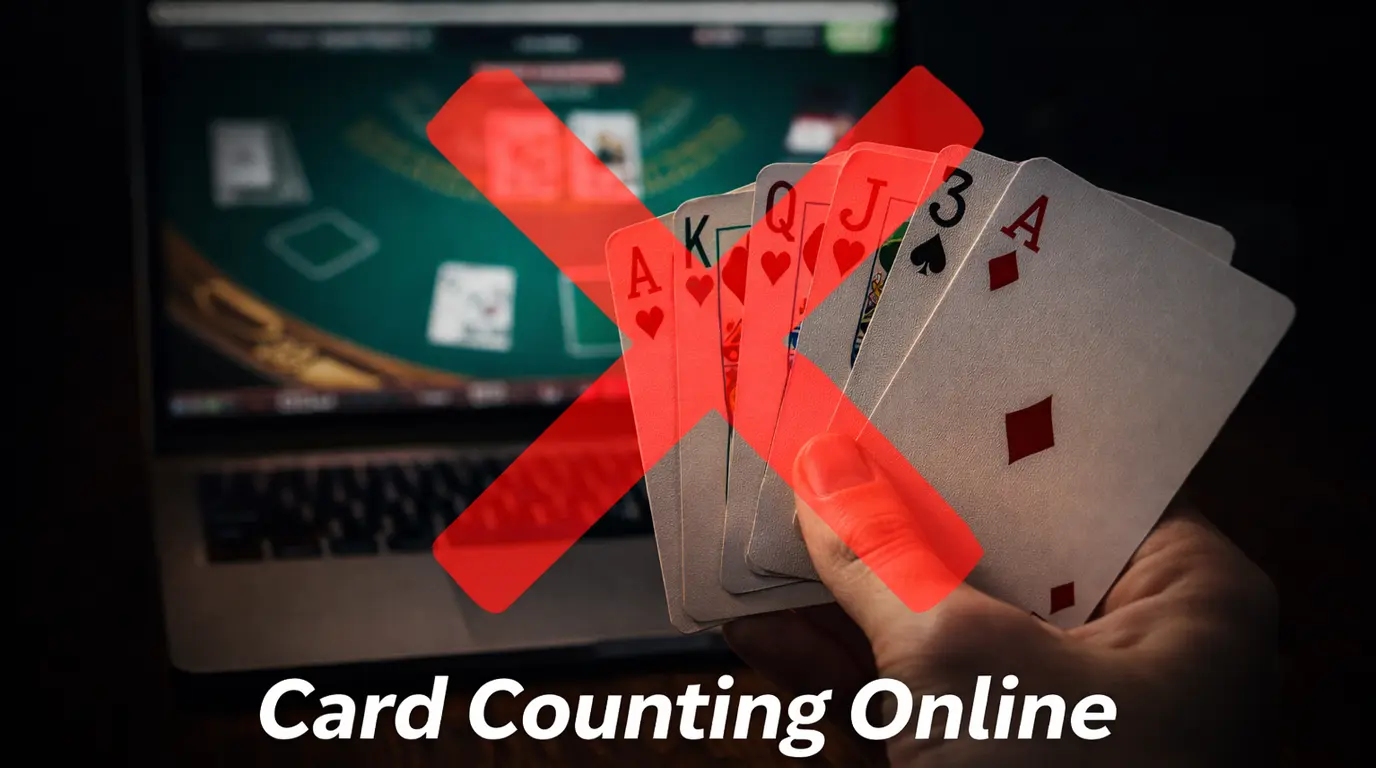
Card Counting — A Live-Table Strategy with No Digital Future
Card counting requires a finite shoe — online blackjack reshuffles after every hand. That single fact renders the entire discipline irrelevant in digital play, but it has not stopped players from trying, and it has not stopped online guides from implying otherwise. The technique is real, the mathematics behind it is sound, and in a physical casino with a dealt shoe, it can shift the odds marginally in the player’s favour. None of those things matter when the software resets the deck between every round.
The appeal is understandable. Card counting is one of the few legitimate methods that can give a player a statistical edge over the house in blackjack. It has been the subject of books, films, and a fair amount of mythology. But its requirements are specific and rigid: a fixed shoe that depletes as cards are dealt, sufficient penetration (the percentage of the shoe dealt before reshuffling), and a bet-sizing scheme that exploits favourable counts. Online blackjack, in both its RNG and live dealer forms, breaks one or more of these requirements by design.
This article explains how card counting actually works, why it fails against digital blackjack, and whether live dealer games offer any exploitable window.
How Card Counting Works in Physical Casinos
The Hi-Lo system assigns values to cards and tracks the running count. It is the most widely taught counting system and the foundation for more advanced methods. Every card dealt is categorised: cards 2 through 6 are assigned a value of +1, cards 7 through 9 are neutral (0), and 10-value cards plus aces are assigned -1. As cards leave the shoe, the counter keeps a running total. When the count is high (positive), the remaining shoe contains a disproportionate number of tens and aces, which favours the player. When the count is low (negative), the shoe is rich in small cards, which favours the dealer.
The running count is then converted into a “true count” by dividing by the estimated number of decks remaining. If the running count is +6 and approximately two decks remain, the true count is +3. The true count is the actionable number — it tells the counter when to increase bet size and when to deviate from basic strategy.
The edge from counting is not large. A skilled counter operating a Hi-Lo system at a six-deck game with 75% penetration might achieve a player edge of 0.5% to 1.5% over the house, depending on bet spread and playing conditions. That edge comes not from winning more hands but from betting more when the remaining cards statistically favour the player and less when they do not. Over thousands of hands, the selective bet sizing accumulates into a net positive expected value.
The system works because of a fundamental property of physical card games: cards already dealt do not return to the shoe until the next shuffle. Every card removed changes the composition of the remaining deck, and that changed composition alters the probabilities of every subsequent outcome. A shoe that has already delivered a high proportion of small cards will, by mathematical necessity, deliver a higher proportion of large cards in the remaining rounds. Card counting exploits this dependency. Without it, there is nothing to count.
In a physical casino, the limitations are practical: the casino can shuffle more frequently, reduce penetration, use continuous shuffling machines, limit bet spreads, or simply ask suspected counters to leave. The strategy is legal in the UK and most other jurisdictions, but casinos are private businesses with the right to refuse service. The adversarial dynamic between counter and casino is well documented and entirely beside the point for online play, where the technical barrier is absolute rather than practical.
Why Card Counting Fails Against RNG Blackjack
Virtual shuffling between every hand makes deck penetration zero. In RNG-based online blackjack, the software simulates a fresh shuffle before each round. The cards dealt in hand one have no relationship to the cards dealt in hand two. The “shoe” is replenished to its full composition after every single hand, which means the probability distribution of the next card is always identical — it never shifts based on what has already been dealt.
This is not a penetration problem that could theoretically be overcome with a larger bet spread or a more aggressive counting system. It is a structural impossibility. Card counting derives its power from the depletion of a finite resource: the shoe. When the shoe is restored to its original state between every hand, depletion does not occur. The running count after any number of hands is always zero in expectation, because no information carries forward from one round to the next.
Some players argue that software-based random number generators might produce sequences that could be tracked or predicted. This misunderstands what an RNG does. The generator does not simulate dealing from a shoe — it independently determines each card using a cryptographic pseudo-random algorithm that produces outcomes indistinguishable from true randomness. Even if you recorded every card dealt over a million hands, the data would not help you predict hand 1,000,001, because each outcome is statistically independent.
The bottom line: card counting against RNG blackjack is not a losing strategy. It is not a strategy at all. It is a method applied to a system that lacks the property the method exploits. You might as well count the results of a coin flip and expect the information to predict the next toss.
Live Dealer Blackjack — Does Counting Work There?
Live shoes are typically eight-deck with early shuffle points — the window is almost nonexistent. Live dealer blackjack uses physical cards dealt from a real shoe, which means the theoretical basis for card counting exists: cards leave the shoe and do not return until the next shuffle. This is where the optimism ends.
The penetration on live dealer blackjack is deliberately shallow. Most providers, including Evolution and Pragmatic Play, shuffle the eight-deck shoe well before the halfway point — often at 50% penetration or less. At that depth, the true count rarely reaches levels that would justify significant bet increases. The variance within a shallow shoe overwhelms the tiny edge that counting might produce.
Bet-timing restrictions add another layer of difficulty. Live blackjack tables have fixed betting windows and limited bet ranges. The dramatic bet spreads that make counting profitable in physical casinos — betting 1 unit at negative counts and 10 to 20 units at high positive counts — are constrained by table limits and by the platform’s ability to flag unusual betting patterns. Automated systems monitor bet sizing, and accounts displaying counter-like behaviour can be restricted.
The practical expected value of counting in live online blackjack is effectively zero or marginally negative once you factor in the time cost, the shallow penetration, and the bet-spread constraints. A player could count perfectly for hours and never encounter a high enough true count to justify deviating from a flat bet. The theoretical edge exists on paper. In practice, the conditions needed to realise it do not materialise at live online tables with any useful frequency.
There is also the question of opportunity cost. The hours spent counting at a live table with minimal edge could be spent playing a well-chosen variant with basic strategy, where the guaranteed reduction in house edge — from 2% or more without strategy to 0.4% with it — delivers a far more reliable improvement. Counting is a marginal optimisation on top of basic strategy. For online play, it is a marginal optimisation with no margin left.
The Edge That Is Not There
Online card counting is a fantasy built on misapplying a physical-world technique to a digital environment. The maths of counting is real. The prerequisites it demands — a depleting shoe with sufficient penetration and freedom to vary bets — are absent from every form of online blackjack that matters.
If you want to reduce the house edge at online blackjack, the tools are straightforward and available: learn basic strategy, choose a variant with favourable rules, and avoid side bets that inflate the casino’s margin. These actions are provably effective, require no covert technique, and work every time you sit down. Card counting, by contrast, requires conditions that the online environment is specifically designed to prevent.
Save the counting for a trip to a physical casino where the shoe is real and the penetration is deep. Online, the most effective strategy is also the most boring one: play the chart, pick the right table, and manage your bankroll. No mythology required.
Visit casinogamesrealmoneyuk for full UK real money casino game guides and reviews.
Separate fact from fiction in our Online Casino Myths article.